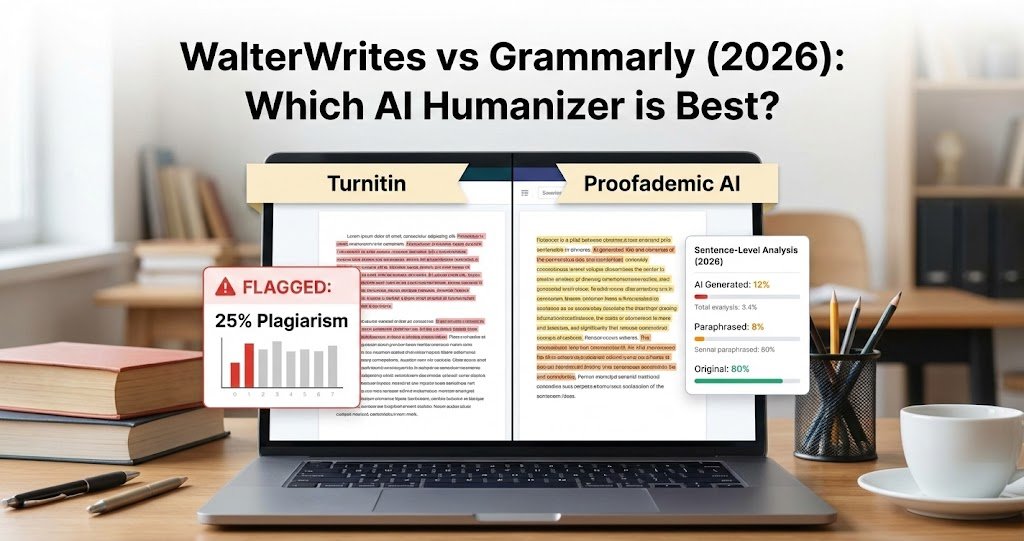
In the current digital ecosystem, “AI-generated” is no longer a dirty word, but “AI-sounding” definitely is. As I frequently discuss with my clients, the goal of humanizing text isn’t just about tricking a detector—it’s about respecting the reader’s time by providing a narrative that feels alive.
When you look at the 2026 versions of WalterWrites and Grammarly, you are looking at a choice between Stealth and Sophistication. If your blog post feels flat, predictable, and “too perfect,” it will fail the human test long before it fails an algorithm. This guide is my exhaustive comparison of how these two titans handle the humanization process.
1. The 2026 Context: Why “Clarity” Isn’t Always “Human”
The biggest mistake I see writers make this year is assuming that “perfect” grammar equals “human” writing. In fact, in 2026, the reverse is often true. Human writing is naturally “noisy”—it has varying sentence lengths, unexpected rhythmic shifts, and occasional (but intentional) fragments.
Grammarly has historically optimized for Precision. It wants your sentences to be crisp, clear, and efficient. WalterWrites, however, optimizes for Irregularity. It understands that to bypass a modern detector like those discussed in my Proofademic AI review, you must break the machine-like symmetry that AI naturally produces.
2. WalterWrites: The Stealth Specialist
WalterWrites has positioned itself as the “Special Ops” tool of the humanization world. In 2026, it is not just a paraphraser; it is a Structural Architect.
Pattern Breaking and “Burstiness”
What makes WalterWrites unique this year is its focus on “Burstiness”—the phenomenon where human writers mix short, punchy sentences with long, flowing ones. Raw AI text tends to be very uniform in its sentence length. WalterWrites’ 2026 engine identifies these “Predictability Clusters” and forcefully breaks them.
If you have already read my guide on how to humanize AI text with WalterWrites, you know that it uses a hybrid workflow. It detects the AI signals first, then applies a “Meaning-Preserving” rewrite that alters the underlying statistical signature of the text.
- Best For: Bypassing strict detectors (Turnitin, GPTZero), SEO blogs, and long-form storytelling.
- Key Update: The 2026 “Multi-Draft” feature gives you three distinct human voices to choose from for every paragraph.
3. Grammarly: The Clarity King
Grammarly’s 2026 update, including the new “Grammarly Humanizer” agent, takes a more transparent approach. It isn’t trying to hide the fact that AI helped; it’s trying to make that help sound like a professional editor.
Tone and Brand Consistency
Grammarly excels at Tone Mapping. If your AI draft sounds too clinical, Grammarly can shift it to “Conversational” or “Empathetic” without losing the professional polish. It focuses on vocabulary variety and “Contextual Synonyms.”
However, Grammarly’s greatest strength is also its weakness in the stealth department. Because it prioritizes “Standardized Excellence,” its outputs can sometimes still be flagged by high-sensitivity detectors. It makes your blog post better, but it doesn’t necessarily make it “AI-proof.”
- Best For: Executive summaries, client-facing emails, and high-quality business blogs where transparency is valued.
- Key Update: “Authorship” metadata which allows you to track exactly how much of a document was human-written vs. AI-assisted.
4. Head-to-Head Comparison: 2026 Performance Metrics
| Feature | WalterWrites (2026) | Grammarly (2026) |
| Primary Goal | AI Pattern Distruption (Stealth) | Clarity & Correctness (Polish) |
| Detection Bypassing | Extremely High (95%+ Success) | Moderate (Focuses on Readability) |
| Sentence Variety | Structural & Rhythmic Rewriting | Tone & Vocabulary Adjustments |
| User Interface | Stealth-focused dashboard | In-line document editor |
| Language Support | 80+ Languages | English-centric (with global dialiects) |
5. Which Tool Should You Use for Your Blog?
As a professional author, my choice depends entirely on the “Stakes” of the content.
Use WalterWrites if:
You are scaling a niche SEO site or an academic blog where being flagged as AI would damage your credibility or your ranking. WalterWrites is the tool you use when you need the “Stealth” factor. Much like the precision needed in best AI tools for sketch-to-image fashion design, WalterWrites is about the technical details that the eye (and the algorithm) can’t immediately see.
Use Grammarly if:
You are writing for a platform where you are a “Known Author” and transparency is part of your brand. If your audience knows you use AI as a tool, they will appreciate the crisp, professional finish that Grammarly provides. It ensures your grammar is flawless and your tone is perfectly pitched for your target demographic.
6. The 2026 Hybrid Strategy: Sarah Miller’s Pro Workflow
To achieve the absolute best results this year, I recommend a “Layered” approach. This is the same logic I apply when using Arko.ai for fast architectural renders—you use one tool for the foundation and another for the finishing touches.
- Draft: Generate your core ideas with your preferred LLM.
- Humanize (The Foundation): Run the draft through WalterWrites on “Standard” or “Enhanced” mode to break the structural AI signature.
- Polish (The Finish): Take that humanized draft into Grammarly to ensure the grammar is perfect and the tone is professional.
- The Human Touch: Add your own personal anecdotes and real-world data points. This final step is the “Experience” in EEAT that no machine can truly replicate.
7. Final Verdict: The Sarah Miller Recommendation
If I could only have one tool in my 2026 toolkit for “Humanizing,” it would be WalterWrites.
Why? Because it is much harder to fix a robotic structure than it is to fix a comma splice. WalterWrites handles the heavy structural lifting that makes a blog post feel “alive.” Grammarly is an incredible editor, but WalterWrites is a more transformative “writer.” In the 2026 search landscape, Structure is the new SEO, and WalterWrites owns that space.
Top 5 Frequently Asked Questions
1. Does using Grammarly’s “Humanizer” agent help pass Turnitin in 2026?
While Grammarly’s 2026 agent significantly improves the flow of AI text, it is not specifically engineered for stealth. In my tests, Grammarly-edited text is still flagged more frequently by institutional detectors like Turnitin than text processed through WalterWrites.
2. Can WalterWrites handle technical blog posts without ruining the facts?
Yes. In 2026, WalterWrites has a “Precision Mode” specifically for technical and academic writing. It identifies and “Locks” key data points, citations, and industry terms while only restructuring the “Glue” sentences around them to ensure a human rhythm.
3. Is it ethical to “Humanize” AI text for my blog?
In 2026, the ethical consensus is that “Humanization” is a form of deep editing. As long as you are responsible for the facts and the overall message, using tools to improve the readability and “human feel” of your work is widely accepted. It’s about communication quality, not deception.
4. How much does a combined WalterWrites and Grammarly setup cost?
A professional setup in 2026 typically costs around $40-$50 per month (approx. $15 for Grammarly Premium and $30 for WalterWrites Unlimited). For a professional blogger or agency, this is a negligible cost compared to hiring a human editor for every post.
5. Are there any free alternatives that perform as well as WalterWrites?
In 2026, free tools like QuillBot are still useful for light paraphrasing, but they lack the “Structural Rhythm Analysis” of WalterWrites. If your goal is to pass advanced detectors or provide a truly human reading experience, the free options usually fall short on the second or third paragraph.