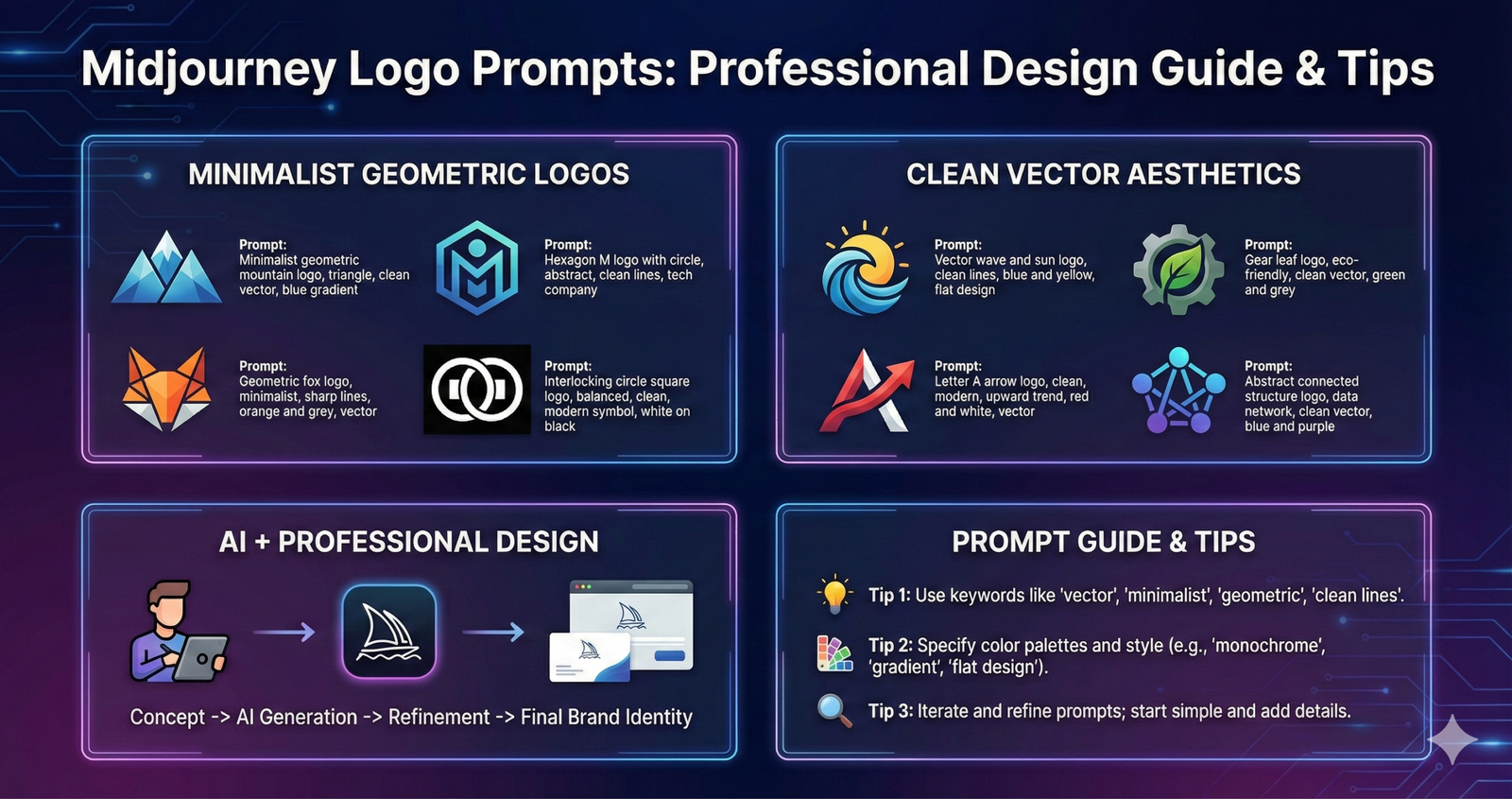
Your brand deserves better than generic stock logos or the cookie-cutter templates every competitor uses. A powerful logo communicates your values instantly, creates lasting impressions, and serves as the visual foundation of your entire brand identity. Yet professional logo design traditionally costs hundreds or thousands of dollars, and freelance designers require weeks of revisions before delivering something that truly resonates.
Midjourney changes this equation completely. This AI-powered image generator creates stunning, professional-quality logo concepts in seconds rather than weeks. When armed with the right prompts, Midjourney becomes your on-demand creative team, capable of exploring hundreds of visual directions, testing diverse styles, and producing polished designs that capture your brand’s essence—all at a fraction of traditional design costs.
The difference between frustration and success lies entirely in prompt craftsmanship. Vague instructions produce generic, unusable outputs that look like every other AI-generated design flooding the market. Strategic, well-structured prompts deliver unique, memorable logos that stand out and effectively represent your brand identity.
After generating thousands of logos across dozens of industries using Midjourney’s various versions, I’ve identified the exact prompt formulas that consistently produce exceptional results. This comprehensive guide reveals battle-tested techniques, industry-specific templates, and professional workflows that transform Midjourney from a random image generator into a precision branding tool. Similar to how Midjourney V7 introduced revolutionary features that enhanced image generation, mastering logo prompts unlocks capabilities most users never discover.
Understanding Midjourney’s Logo Design Capabilities and Limitations
Midjourney excels at creating visual logo concepts, symbols, and design exploration but struggles with text rendering and requires human refinement to produce final, production-ready files.
Before diving into specific prompts, understanding what Midjourney does brilliantly and where it falls short ensures realistic expectations and optimal workflows.
Midjourney’s strengths center on visual creativity and rapid concept generation. It explores design directions faster than human designers, creates unexpected visual combinations that spark fresh ideas, and produces high-quality imagery suitable for initial presentations and concept validation. The AI understands design principles like balance, contrast, and hierarchy when properly prompted, making it surprisingly capable of generating aesthetically pleasing compositions.
The platform particularly shines when creating pictorial marks, abstract symbols, mascot logos, emblem designs, and minimalist geometric compositions. These logo types rely on visual elements rather than text, playing to Midjourney’s strengths. It can produce hundreds of variations exploring different color palettes, compositional arrangements, and stylistic approaches in the time a human designer creates a handful of sketches.
However, Midjourney has critical limitations that affect professional logo work. The most significant constraint is text rendering—Midjourney notoriously struggles with accurate typography, often producing garbled letters, incorrect spelling, or awkwardly positioned text. While recent versions like V7 show improvements in text handling, particularly for simple words and phrases, the results remain inconsistent and unreliable for professional branding.
This text limitation means Midjourney-generated logos almost always require post-processing in design software like Adobe Illustrator, Photoshop, Canva, or free alternatives like Photopea. You’ll use Midjourney to generate the visual symbol or icon, then add clean, professionally typeset text using traditional design tools.
Another important consideration involves vector conversion. Logos need to scale from business card size to billboard dimensions without quality loss, requiring vector formats rather than raster images. Midjourney outputs raster files, meaning you’ll need to either manually recreate designs as vectors or use auto-tracing tools to convert the AI-generated concepts into scalable formats.
Finally, Midjourney tends toward visual complexity and realism by default. Creating the simple, clean designs that make effective logos requires explicit instructions telling the AI what to avoid—namely excessive detail, shading, textures, and realistic rendering. Without these constraints, you’ll receive beautiful but impractical designs that lose clarity when scaled down or reproduced in single colors.
Understanding these realities shapes effective workflows: use Midjourney for rapid ideation and concept exploration, select the strongest visual directions, then refine and finalize using traditional design tools. This hybrid approach combines AI’s creative speed with human design expertise and technical precision.
Essential Prompt Structure for Logo Design Success
Crafting effective Midjourney logo prompts follows a consistent framework that guides the AI toward professional, usable results rather than generic decorative imagery.
- Component 1: Logo Type Declaration Start by explicitly stating you’re creating a logo. Keywords like “logo,” “logo design,” “vector logo,” “symbol,” or “emblem” signal intent and influence Midjourney’s output style. Without this declaration, the AI might produce detailed illustrations unsuitable for branding purposes.
- Component 2: Subject or Concept Clearly describe what the logo represents—the industry, company type, or core concept. Be specific: “tech startup” differs from “sustainable fashion brand” or “artisan coffee roastery.” This context guides visual metaphors and stylistic choices.
- Component 3: Visual Style Direction Specify the aesthetic approach using design terminology. Reference established styles like “minimalist,” “geometric,” “line art,” “Bauhaus,” “Swiss design,” “abstract,” “modern,” or “vintage.” Each triggers different visual interpretations.
- Component 4: Simplicity Constraints Explicitly constrain complexity with terms like “simple,” “clean,” “minimal,” “flat,” “vector,” or “no shading detail.” These instructions fight Midjourney’s tendency toward elaborate, realistic rendering.
- Component 5: Color Specification Define your color approach: “monochrome,” “black and white,” “duotone blue and teal,” “vibrant gradient,” or specific color names. Color significantly impacts brand perception and practical logo versatility.
- Component 6: Technical Parameters Include Midjourney parameters that enhance logo suitability. Essential parameters include
--no realistic photo detail shading texture,--ar 1:1(square aspect ratio), and potentially--style rawfor cleaner output. - Component 7: Designer or Style Reference (Optional) Mentioning famous logo designers or design movements provides stylistic guidance. Names like Paul Rand, Saul Bass, Massimo Vignelli, or studios like Pentagram influence aesthetic direction based on their iconic work.
A weak prompt looks like: “make a logo for my business”
An effective prompt follows this structure: “flat vector logo design for organic skincare brand, minimalist leaf symbol, clean geometric shapes, sage green and cream color palette, simple, no shading or texture –no realistic detail –ar 1:1”
The improved version provides logo type, industry context, visual concept, style constraints, color direction, simplicity requirements, and technical parameters. Midjourney can work with this precision to deliver relevant, usable concepts.
Foundational Logo Prompt Templates by Type
Different logo types require tailored prompting approaches. These templates provide starting points for major logo categories.
Lettermark and Monogram Logos
Lettermark logos feature stylized letters or initials. While challenging due to Midjourney’s text limitations, they’re possible with careful prompting and expectation that you’ll refine typography post-generation.
- Template: “lettermark logo design using letter [letter], [style description], vector, simple, clean lines, [color palette], serif/sans-serif font inspiration, minimal –no realistic detail shading –ar 1:1”
- Example: “lettermark logo design using letter M, art deco style, geometric symmetry, gold and black color scheme, elegant serif font inspiration, vector, simple –no realistic photo detail –ar 1:1”
These prompts produce letter-based concepts that capture the aesthetic direction even if the exact letterforms require manual recreation in design software.
Pictorial and Symbol Marks
Pictorial marks use recognizable images or abstract symbols to represent brands. This category plays to Midjourney’s strengths since it avoids text entirely.
- Template: “pictorial mark logo design, [subject/concept], [style descriptors], [color palette], simple vector style, clean, flat design, no text –no shading realistic detail texture –ar 1:1”
- Example: “pictorial mark logo design, mountain peak with rising sun, minimalist geometric style, navy blue and orange, simple vector style, clean, flat design, no text –no shading realistic detail texture –ar 1:1”
The absence of text requirements lets you focus entirely on creating compelling visual symbols that communicate brand values through imagery alone.
Abstract Symbol Logos
Abstract logos use geometric or organic shapes to create unique marks without representing literal objects. These designs often feel modern and allow flexibility in brand interpretation.
- Template: “abstract logo design, [geometric/organic description], [style], [color approach], clean vector, minimal, simple forms, no detail –no realistic shading texture –ar 1:1”
- Example: “abstract logo design, flowing circular ribbons, modern minimalist style, gradient from teal to purple, clean vector, minimal, simple forms, no detail –no realistic shading texture –ar 1:1”
Abstract designs require careful refinement to ensure the final symbol feels intentional and memorable rather than randomly generated.
Mascot and Character Logos
Mascot logos feature illustrated characters representing the brand. These work well for companies targeting specific demographics or seeking friendly, approachable branding.
- Template: “mascot logo design, [character description], [personality traits], simplified cartoon style, [color palette], vector illustration, clean lines, friendly, no background –no realistic photo detail shading –ar 1:1”
- Example: “mascot logo design, friendly robot character, playful and innovative personality, simplified cartoon style, blue and silver color palette, vector illustration, clean lines, friendly, no background –no realistic photo detail shading –ar 1:1”
Mascot designs benefit from personality descriptors that guide character expression and pose. Just as effective ChatGPT prompts require specific instructions, mascot prompts need clear character definition.
Emblem and Badge Logos
Emblem logos contain text inside symbols, badges, or crests. These traditional designs convey heritage, authority, and craftsmanship.
- Template: “emblem logo design, [shape: circular/shield/badge], [central symbol], [decorative elements], vintage/modern style, [color palette], detailed border, vector, clean –no realistic photo –ar 1:1”
- Example: “emblem logo design, circular badge, anchor symbol in center, rope border detail, vintage nautical style, navy and gold color palette, detailed border, vector, clean –no realistic photo –ar 1:1”
Emblem designs work best when you plan to add text manually after generation, using the AI output for the symbolic and decorative framework.
Industry-Specific Logo Prompts That Convert
Different industries require distinct aesthetic approaches. These templates target specific business categories with appropriate visual language.
Technology and SaaS Companies
Tech logos typically emphasize innovation, precision, and forward-thinking through clean geometry and modern aesthetics.
- Startup/Innovation Focus: “modern tech startup logo, geometric abstract symbol, minimalist design, cool blue and electric purple gradient, sleek vector, cutting-edge feel, simple –no detail realistic –ar 1:1”
- Enterprise Software: “professional software company logo, interconnected nodes network pattern, sophisticated minimalist style, corporate blue monochrome, clean vector, trust and reliability –no shading texture –ar 1:1”
- AI/Machine Learning: “artificial intelligence company logo, neural network inspired design, futuristic geometric pattern, cyan and white color scheme, modern vector, innovative –no realistic detail –ar 1:1”
Tech logos benefit from geometric precision and digital-feeling aesthetics that communicate technological sophistication.
Health and Wellness Brands
Health industry logos must communicate trust, care, and expertise while remaining approachable and reassuring.
- Medical/Healthcare: “healthcare provider logo, stylized heartbeat symbol combined with cross, professional minimalist style, medical blue and green, clean vector, trustworthy –no shading detail –ar 1:1”
- Wellness and Holistic: “wellness brand logo, lotus flower with flowing water, organic natural style, sage green and soft lavender, peaceful minimalist design, vector –no realistic detail –ar 1:1”
- Fitness and Nutrition: “fitness brand logo, dynamic human figure in motion, energetic modern style, vibrant orange and black, strong clean lines, motivational –no shading texture –ar 1:1”
Health logos balance professionalism with warmth, avoiding overly clinical aesthetics that might feel cold or impersonal.
Food and Beverage Businesses
Food industry logos evoke appetite, quality, and specific culinary traditions through color, imagery, and style choices.
- Restaurant and Dining: “upscale restaurant logo, elegant chef’s hat and crossed utensils, sophisticated minimalist style, gold and charcoal color palette, refined vector –no realistic detail –ar 1:1”
- Coffee Shop: “artisan coffee shop logo, steaming coffee cup with coffee bean accents, warm inviting style, rich brown and cream colors, cozy vintage feel, hand-drawn aesthetic –no photo realistic –ar 1:1”
- Organic/Natural Foods: “organic food brand logo, farm-to-table concept with wheat and vegetables, rustic hand-drawn style, earthy green and brown tones, authentic natural feel –no shading detail –ar 1:1”
Food logos leverage visual appetite appeal while communicating quality standards and culinary positioning.
Creative and Design Services
Creative industry logos showcase artistic capability while maintaining professional credibility—a delicate balance.
- Design Agency: “creative design agency logo, abstract geometric shapes forming letter C and A, bold modern style, vibrant color blocked design, innovative vector –no realistic shading –ar 1:1”
- Photography: “photography studio logo, minimalist camera aperture symbol, clean professional style, monochrome black and white, elegant simple vector –no detail texture –ar 1:1”
- Marketing and Advertising: “marketing agency logo, megaphone with sound wave elements, energetic modern style, bright red and electric blue, dynamic clean vector –no realistic detail –ar 1:1”
Creative services logos must demonstrate design sophistication without becoming overly complex or difficult to reproduce across media.
Professional Services
Professional services logos communicate expertise, trustworthiness, and established authority through conservative yet distinctive design.
- Legal Services: “law firm logo, balanced scales with pillar elements, traditional sophisticated style, deep navy and gold, authoritative clean vector –no shading detail –ar 1:1”
- Financial Services: “financial advisory logo, upward arrow with shield symbol, trustworthy modern style, professional blue and silver, stability confidence –no realistic texture –ar 1:1”
- Consulting: “business consulting logo, interconnected puzzle pieces, strategic modern style, corporate teal and charcoal, professional clean vector –no detail shading –ar 1:1”
Professional services require conservative aesthetics that inspire confidence without appearing dated or generic.
Retail and E-commerce
Retail logos must appeal to target demographics while standing out in crowded marketplaces and translating across digital and physical applications.
- Fashion and Apparel: “fashion boutique logo, elegant letter F with flourish detail, chic minimalist style, black and rose gold, sophisticated vector, luxury feel –no realistic shading –ar 1:1”
- E-commerce Platform: “online marketplace logo, shopping bag with digital cursor element, modern friendly style, vibrant multi-color palette, approachable clean vector –no detail texture –ar 1:1”
- Sustainable Products: “eco-friendly retail logo, circular leaf pattern, modern organic style, fresh green and earth brown, environmental conscious design –no realistic detail –ar 1:1”
Retail logos balance trend-awareness with timeless appeal, avoiding designs that will feel dated within a single season.
Advanced Prompt Engineering Techniques
These advanced strategies maximize Midjourney’s logo generation potential beyond basic templates.
Leveraging Design Movements and Styles
Referencing established design movements triggers specific aesthetic frameworks that influence composition, color, and form.
Bauhaus Influence: “logo design for architecture firm, Bauhaus inspired, geometric primary shapes, limited color palette of red yellow blue, functional minimalism, clean vector –no ornament detail –ar 1:1”
The Bauhaus movement emphasized functional simplicity and geometric forms, making it perfect for modern, rational brand aesthetics.
Swiss Design Approach: “logo design for financial institution, Swiss design style, grid-based geometric composition, clean sans-serif typography inspiration, neutral color palette, objective minimalist –no decoration –ar 1:1”
Swiss design (International Typographic Style) brings precision, clarity, and mathematical grid systems to logo compositions.
Art Deco Aesthetic: “logo design for luxury hotel, Art Deco style, symmetrical geometric ornament, gold and black color scheme, elegant stylized forms, sophisticated –no realistic shading –ar 1:1”
Art Deco references communicate luxury, glamour, and timeless elegance through distinctive geometric patterns and metallic palettes.
Mid-Century Modern: “logo design for furniture company, mid-century modern style, organic geometric shapes, warm retro color palette of orange teal and cream, playful sophisticated –no detail texture –ar 1:1”
Mid-century modernism balances organic and geometric forms with optimistic color palettes perfect for contemporary brands seeking vintage charm.
Referencing Famous Logo Designers
Mentioning iconic designers leverages their distinctive styles and design philosophies to guide Midjourney’s output.
Paul Rand Style: “logo design in Paul Rand style, geometric abstraction, clever visual play, bold primary colors, simple powerful forms, iconic –no realistic detail –ar 1:1”
Paul Rand created legendary logos for IBM, ABC, and UPS using geometric abstraction and visual wit.
Saul Bass Approach: “logo design in Saul Bass style, minimalist geometric symbol, dynamic composition, limited color palette, cinematic bold design –no shading texture –ar 1:1”
Saul Bass pioneered minimalist, kinetic logo designs that communicate through simplified, dynamic forms.
Massimo Vignelli Philosophy: “logo design following Massimo Vignelli principles, timeless modernist aesthetic, grid-based geometry, restrained color, intellectual clarity –no ornament –ar 1:1”
Vignelli championed intellectual rigor and timeless simplicity in design, creating enduring brand identities.
These designer references work because Midjourney’s training data includes their iconic work, allowing the AI to emulate their distinctive approaches.
Using Negative Prompts for Precision Control
The --no parameter tells Midjourney what to exclude, proving exceptionally valuable for logo work where simplicity and clarity trump decorative complexity.
Essential Negative Prompts for Logos: --no realistic photo detail shading texture gradient background ornament
This comprehensive exclusion list prevents common logo-inappropriate elements. Breaking it down:
- “realistic photo” – Avoids photographic rendering
- “detail” – Prevents excessive elaboration
- “shading” – Removes dimensional lighting
- “texture” – Eliminates surface complexity
- “gradient” – Stops color transitions (when seeking flat design)
- “background” – Ensures isolated logo on white/transparent
- “ornament” – Removes decorative embellishments
Customize negative prompts based on specific needs. For ultra-minimal designs, add more exclusions. For slightly more elaborate concepts, reduce constraints.
Combining Image References with Prompts
Midjourney allows image URLs as prompt components, letting you guide outputs toward specific visual directions using reference images.
Using Style References: Upload or link to logos you admire, then reference them in prompts:
“logo design for eco-tourism company, minimalist mountain symbol [image URL], similar geometric style, green and brown color palette, clean vector –no realistic detail –ar 1:1”
The reference image guides compositional approach, level of detail, and aesthetic direction without directly copying.
Blending Multiple References: Combine several image references to merge different stylistic elements:
“logo design [vintage badge reference URL] [modern minimalist reference URL], blend traditional and contemporary elements, balanced fusion –ar 1:1”
This technique creates unique hybrids that wouldn’t emerge from text prompts alone.
Iterative Refinement Through Variations
Rather than expecting perfect results from single prompts, employ iterative workflows that progressively refine toward ideal outcomes.
- Stage 1: Broad Exploration Generate 16-20 concepts using deliberately varied prompts exploring different styles, symbols, and approaches.
- Stage 2: Direction Selection Identify 2-3 promising visual directions from initial exploration. These might share certain elements while differing in details.
- Stage 3: Focused Refinement Create variations on selected concepts, adjusting specific parameters like color, composition, or style intensity.
- Stage 4: Final Optimization Fine-tune the strongest concepts with precise parameter adjustments until you achieve production-worthy base designs.
This systematic approach prevents decision paralysis while ensuring thorough exploration before committing to final designs. The process mirrors how different AI tools excel through iteration rather than single attempts.
Midjourney Parameters That Matter for Logos
Understanding and strategically using Midjourney’s parameters significantly impacts logo quality and usability.
Aspect Ratio (–ar)
Logos typically require square or horizontal formats rather than vertical orientations.
--ar 1:1 – Perfect square, ideal for most logos that need to work across various applications --ar 3:2 – Slightly horizontal, works for wordmarks or horizontal lockups --ar 2:1 – Distinctly horizontal, suitable for wide wordmarks
Square aspect ratios ensure the logo works equally well in profile pictures, app icons, and square social media formats.
Quality (–q)
The quality parameter affects rendering detail and generation time, with logo-specific considerations.
--q 0.5 or --q 1 – Sufficient for simple logo concepts; faster generation allows more exploration --q 2 – Higher quality for detailed emblems or complex symbols (note: costs more GPU time)
For logo work, standard quality usually suffices since excessive detail becomes problematic when scaling down. Draft Mode in V7 provides even faster iteration for initial concept exploration.
Stylize (–s)
The stylize parameter controls how strongly Midjourney applies its aesthetic training versus following your prompt literally.
--s 50 to --s 250 – Lower stylization for logos ensures your specific directions dominate over Midjourney’s artistic interpretation --s 500 to --s 750 – Moderate range allowing some aesthetic enhancement while maintaining control
Logos generally benefit from lower stylization values that prioritize prompt adherence over artistic interpretation.
Chaos (–c)
Chaos increases variation between the four generated images, useful for exploring diverse concepts.
--c 0 to --c 25 – Low chaos for consistent, controlled variations when refining a direction --c 40 to --c 80 – Higher chaos for initial exploration when seeking diverse concepts
Use higher chaos during early exploration, then reduce it when refining promising directions.
Version Selection (–v)
Different Midjourney versions have distinct characteristics affecting logo suitability.
--v 7 – Latest version with improved text handling (though still imperfect), better prompt understanding, enhanced style control --v 6.1 – Previous version, well-tested with predictable outputs --v 6 – Reliable for certain aesthetic approaches, extensive community knowledge
Version 7 represents the current recommended option for logo work, offering improved capabilities particularly around simple text and geometric forms.
Workflow: From Concept to Final Logo File
Professional logo delivery requires more than generating images in Midjourney. This workflow transforms AI concepts into production-ready files.
Step 1: Define Brand Parameters
Before touching Midjourney, clarify essential brand elements:
- Industry and target audience
- Brand personality traits (innovative, trustworthy, playful, sophisticated, etc.)
- Color preferences or requirements
- Competitor landscape and differentiation needs
- Specific symbols or concepts to explore or avoid
This foundation ensures prompts align with actual brand strategy rather than random creative exploration.
Step 2: Generate Concept Options
Create 20-50 initial concepts using diverse prompts exploring:
- Different logo types (pictorial, abstract, geometric, etc.)
- Varied visual metaphors for your industry
- Multiple style approaches (minimal, vintage, modern, etc.)
- Alternative color palettes
Cast a wide net during this phase. Unexpected concepts often outperform initial assumptions about what will work.
Step 3: Select Strongest Directions
Review generated concepts, selecting 3-5 that best align with brand parameters while offering visual distinctiveness. Consider:
- Memorability and uniqueness
- Appropriate industry communication
- Scalability potential (will it work small?)
- Versatility across applications
- Emotional resonance with brand personality
Avoid choosing solely based on personal aesthetic preference. Evaluate through the lens of strategic brand communication.
Step 4: Refine and Iterate
For selected directions, generate variations exploring:
- Color adjustments
- Compositional refinements
- Simplified versus slightly more detailed versions
- Different orientations or arrangements
This refinement narrows toward final concepts while ensuring you’ve thoroughly explored each promising direction.
Step 5: Vector Conversion
Midjourney outputs raster images, but logos require vector formats. Convert using:
Manual Recreation (Highest Quality): Use Adobe Illustrator or Inkscape to manually trace the AI-generated design using vector tools. This provides complete control and precision but requires design skill.
Auto-Tracing (Faster): Use vector tracing software like:
- Adobe Illustrator’s Image Trace
- Vector Magic
- Inkscape’s Trace Bitmap
- Online converters like Vectorizer.ai
Auto-tracing works best on high-contrast, simple designs. Complex or gradient-heavy logos require manual cleanup.
Step 6: Typography Integration
Add text elements using professional typography:
- Select fonts that complement the visual style
- Establish proper hierarchy between company name and tagline
- Ensure readability at various sizes
- Create consistent spacing relationships
This step transforms Midjourney’s visual symbol into a complete, functional logo system.
Step 7: Color Refinement
Develop a complete color system:
- Define exact color values (CMYK for print, RGB for digital, Pantone for brand consistency)
- Create full-color, single-color, and reversed (white on dark) versions
- Test visibility against various backgrounds
- Ensure colors reproduce consistently across media
Professional logos require carefully specified colors rather than approximate visual matching.
Step 8: Create Logo Variations
Develop the complete logo family:
- Primary full-color version
- Secondary one or two-color versions
- Icon-only version (if text is separate)
- Horizontal and stacked lockups
- Minimum size specifications
This comprehensive approach ensures the logo works in every application from business cards to billboards.
Step 9: Build Brand Guidelines
Document proper logo usage:
- Clear space requirements
- Minimum size specifications
- Approved and prohibited color combinations
- Background usage rules
- Incorrect usage examples
Guidelines prevent logo misuse that damages brand consistency over time.
Step 10: Prepare Delivery Files
Package final files including:
- Vector formats (AI, EPS, SVG)
- High-resolution rasters (PNG with transparency, JPG)
- Various sizes and orientations
- Full-color and single-color versions
- Brand guidelines document
Professional file organization prevents future confusion and ensures anyone working with the brand has necessary assets.
Common Mistakes and How to Avoid Them
Even experienced users make logo-specific mistakes with Midjourney. Avoid these pitfalls for better results.
- Mistake 1: Relying on AI-Generated Text Midjourney’s text rendering remains unreliable despite improvements. Always plan to add typography manually in design software rather than fighting with garbled AI text.
- Mistake 2: Choosing Overly Complex Designs Beautiful, detailed Midjourney outputs often make terrible logos because they lose clarity when scaled down. Simple, bold designs outperform intricate ones for actual logo applications.
- Mistake 3: Ignoring Single-Color Requirements Logos must work in one color for various applications (embroidery, engraving, faxes, etc.). Designs relying on gradients, multiple colors, or shading fail this practical test.
- Mistake 4: Skipping Vector Conversion Using raster Midjourney outputs directly creates scaling problems immediately. Always convert to vectors before considering designs finalized.
- Mistake 5: Forgetting Negative Space Effective logos consider both positive and negative space relationships. Midjourney doesn’t automatically optimize negative space, requiring human refinement.
- Mistake 6: Following Trends Too Closely AI tends toward currently popular aesthetics. Logos need longevity beyond immediate trends. Aim for timeless approaches rather than what’s fashionable this year.
- Mistake 7: Insufficient Prompt Specificity Vague prompts produce generic results. Specific instructions about style, simplicity, color, and industry create distinctive, appropriate designs.
- Mistake 8: Not Testing at Multiple Sizes A logo that looks great large might become illegible small. Always test designs at business card size (approximately 1 inch wide) to ensure critical details remain visible.
- Mistake 9: Ignoring Cultural Considerations Symbols carry different meanings across cultures. Research potential cultural interpretations before finalizing designs, especially for international brands.
- Mistake 10: Publishing Without Professional Review Have experienced designers review AI-generated concepts before finalization. They catch issues with balance, proportion, and technical execution that non-designers miss.
Enhancing Midjourney Logos with Post-Processing
Raw Midjourney outputs benefit significantly from professional refinement. These techniques elevate AI concepts to production quality.
Cleaning and Simplifying
Remove unnecessary details that complicate the design:
- Eliminate random embellishments that don’t serve the concept
- Simplify complex curves into cleaner geometry
- Remove subtle textures or shading artifacts
- Strengthen shapes with clearer, more deliberate forms
The goal is distilling the AI’s concept to its essential, most powerful elements.
Perfecting Geometry and Alignment
Midjourney produces organic, slightly irregular shapes. Professional logos require mathematical precision:
- Align elements to precise grids
- Make circles perfectly circular, squares perfectly square
- Ensure symmetrical elements are mathematically symmetrical
- Snap angles to precise degrees (0°, 45°, 90°, etc.)
This geometric refinement creates the professional polish that distinguishes amateur from expert work, similar to how Apple Intelligence features emphasize precision and polish in user experience.
Optimizing Color Relationships
Refine AI-generated color choices:
- Adjust saturation and brightness for better reproduction
- Ensure sufficient contrast for visibility and accessibility
- Harmonize color relationships using color theory principles
- Test colors in context (on various backgrounds, in different media)
Professional color specification prevents the “close enough” approximations that undermine brand consistency.
Creating Responsive Variations
Develop logo versions optimized for different size contexts:
- Simplified icon version for small applications
- Detailed version for large-format usage
- Horizontal and vertical lockups
- Dark and light background versions
Responsive logo systems ensure brand consistency regardless of application size or context.
Adding Strategic Details
Sometimes AI concepts benefit from thoughtful additions:
- Subtle refinements that strengthen symbolism
- Supporting elements that improve balance
- Texture or pattern in appropriate contexts (though usually minimal)
- Dimension through deliberate color relationships rather than shading
Add selectively, always serving the core concept rather than decorating arbitrarily.
Real-World Success Stories
Understanding how others successfully use Midjourney for logo design provides practical insights and realistic expectations.
Tech Startup Visual Identity A SaaS startup used Midjourney to explore 100+ logo concepts in their first week of branding development. By testing abstract geometric symbols with their target audience, they identified unexpected visual directions that traditional design wouldn’t have explored. The final logo combined two AI-generated concepts, refined by a designer into a clean vector mark. Total cost: $300 for designer refinement versus $3,000-5,000 for traditional logo development.
Restaurant Rebranding Exploration An established restaurant used Midjourney to visualize potential rebrand directions before hiring a design firm. The AI explorations clarified which aesthetic approaches resonated with ownership, making the subsequent designer engagement far more efficient. They arrived at meetings with concrete visual references rather than vague verbal descriptions. Designer time reduced by 40%.
E-commerce Brand Family An entrepreneur launching three related e-commerce brands used Midjourney to create cohesive visual families. By maintaining consistent style parameters while varying symbols and colors, they developed distinctive but related brand identities. A designer vectorized and refined all three logos in a single day. Cost savings versus hiring a branding agency: approximately $8,000.
Non-Profit Organization A community non-profit with zero design budget used Midjourney plus Canva to create their complete visual identity. While the result wasn’t perfect, it provided professional-appearing branding that served their needs for two years until growth allowed hiring professional designers. The DIY approach enabled earlier launch versus waiting for funding.
These examples share common elements: they used Midjourney for exploration and concept generation, refined promising directions with human expertise, and achieved significant time or cost savings versus traditional methods alone.
Future of AI in Logo Design
AI logo generation continues evolving rapidly. Understanding emerging trends helps prepare for coming capabilities and limitations.
Improved Text Rendering Midjourney V7 and competing platforms show progressive improvement in text generation. While not yet reliable for final logos, the trajectory suggests AI will eventually handle typography competently, reducing post-processing requirements.
Native Vector Output Current AI generates raster images requiring conversion. Future versions may output native vector formats, eliminating conversion workflows entirely and enabling truly scalable outputs directly from prompts.
Style Consistency Training Users will increasingly train AI on their specific style preferences, enabling consistent brand family generation across multiple related designs. This personalization creates more predictable, on-brand results.
Real-Time Iteration Faster processing and streaming outputs will enable real-time prompt refinement, letting designers see immediate results as they adjust parameters. This conversational design approach will feel more like collaborating with a design partner than submitting isolated requests.
Integrated Design Systems Future AI tools may generate complete brand systems—logos, color palettes, typography recommendations, and application mockups—from single prompts. This holistic approach will accelerate entire brand development processes.
Better Understanding of Design Principles As AI training incorporates more design theory, future models will better understand concepts like visual hierarchy, balance, proportion, and cultural symbolism without requiring explicit prompting for these fundamentals.
Collaboration with Traditional Tools Tighter integration between AI generators and professional design software will streamline workflows. Imagine generating concepts in Midjourney and immediately refining them in Illustrator within a unified interface.
Despite these advances, human design expertise will remain crucial. AI accelerates exploration and execution but lacks the strategic thinking, cultural awareness, and stakeholder management that define professional branding work. The future involves augmented designers working faster and more creatively, not replacement of human creativity.
Legal and Ethical Considerations
Using AI-generated logos involves important legal and ethical questions that responsible designers must address.
Copyright and Ownership
Midjourney’s terms grant you rights to use generated images, but the legal landscape around AI-generated work remains evolving. Key considerations:
- Commercial Rights: Paid Midjourney subscriptions (Standard, Pro, Mega) provide commercial usage rights. Free or Basic plans have restrictions. Always verify current terms before commercial use.
- Copyright Registration: AI-generated works may face challenges in copyright registration since current law requires human authorship. Significant human refinement strengthens ownership claims.
- Derivative Work: Logos refined by human designers from AI concepts likely qualify as derivative works with clearer copyright protection than unmodified AI outputs.
- Trademark Protection: Regardless of creation method, logos can be trademarked if they meet distinctiveness requirements. Focus trademark applications on the refined, final logo rather than raw AI output.
Consult intellectual property attorneys for definitive guidance on your specific situation, especially for high-value brands or competitive industries.
Originality and Similarity
AI models train on existing images, raising questions about originality:
- Similarity Checks: Always search existing logos before finalizing designs. Tools like TinEye, Google Image Search, and trademark databases help identify potential conflicts.
- Unintentional Copying: AI might inadvertently generate designs similar to existing logos. Your responsibility includes verification that final designs don’t infringe existing marks.
- Unique Refinement: Substantial human modification increases originality and reduces similarity risks. Don’t use AI outputs unchanged.
- Industry Standards: Some industries have visual conventions (medical crosses, legal scales, etc.). Ensure your logo adds distinctive elements beyond generic industry symbols.
Disclosure to Clients
Professional ethics involve transparency about AI involvement:
- Client Expectations: Some clients specifically want human-created designs. Disclose AI use before engagement to avoid conflicts.
- Value Proposition: Position AI as a tool enhancing your capabilities, not replacing expertise. Emphasize the strategic thinking, refinement, and brand knowledge you provide.
- Pricing Considerations: AI-accelerated workflows might justify different pricing structures. Be transparent about how AI affects timelines and costs.
- Portfolio Presentation: When showcasing AI-assisted work, consider explaining your process. This demonstrates innovative thinking while maintaining honesty.
Different professionals handle disclosure differently based on client relationships and industry norms. Develop an approach aligned with your values and client expectations.
Environmental Considerations
AI image generation consumes significant computational resources and energy:
- Resource Usage: Each image generation requires GPU processing with environmental costs. Generate thoughtfully rather than creating hundreds of unnecessary variations.
- Efficiency Balance: AI might reduce overall environmental impact compared to extensive traditional design iterations involving printing, shipping, and multiple revision cycles.
- Sustainable Practices: Offset AI generation’s environmental cost through other sustainable business practices and by maximizing the value extracted from each generation session.
While individual logo projects have modest environmental impact, collective AI usage represents significant resource consumption worth considering in professional practices.
Combining Midjourney with Other Design Tools
Professional logo workflows integrate multiple tools, each contributing specific strengths. Strategic combinations produce better results than any single platform.
Midjourney + Adobe Illustrator
This represents the most common professional workflow:
Midjourney’s Role: Concept generation, visual exploration, style testing Illustrator’s Role: Vector conversion, typography, precise refinement, file preparation
Export high-resolution Midjourney outputs, then use Illustrator’s Image Trace or manual pen tool recreation to convert to vectors. Add typography, refine geometry, and prepare final files.
Midjourney + Canva
Budget-friendly workflow for non-designers:
Midjourney’s Role: Generate unique visual symbols Canva’s Role: Add typography, create variations, design brand applications
Upload Midjourney outputs to Canva, use Background Remover to isolate symbols, then add text using Canva’s typography tools. Create business cards, social graphics, and other branded materials within the same platform.
Midjourney + Figma
Modern design workflow particularly suited for digital brands:
Midjourney’s Role: Visual concept creation Figma’s Role: Refinement, component creation, design system development, team collaboration
Import Midjourney concepts into Figma, trace or refine using vector tools, create comprehensive design systems with all logo variations and usage guidelines. Figma’s collaboration features enable team review and iteration.
Midjourney + Photoshop
Useful for certain refinement tasks:
Midjourney’s Role: Base image generation Photoshop’s Role: Color adjustments, mockup creation, detailed cleanup, effects
Use Photoshop to perfect colors, create realistic mockups showing logos in context, and clean up minor imperfections before vector conversion. Photoshop excels at presentation preparation.
Midjourney + Specialized Logo Tools
Platforms like Looka, Tailor Brands, or Hatchful offer logo-specific features:
Hybrid Approach: Generate unique symbols in Midjourney, import into logo platforms for automated variations, color palette suggestions, and instant mockups.
This combination provides AI creativity plus specialized branding tools’ convenience and formatting.
Strategic tool combinations leverage each platform’s strengths while compensating for weaknesses. Professional results rarely come from single-tool workflows. Much like how Microsoft Copilot enhances productivity through integration across multiple applications, combining design tools creates superior outcomes.
Measuring Logo Success Beyond Aesthetics
Beautiful logos that fail business objectives waste resources. Evaluate logo effectiveness through strategic metrics beyond visual appeal.
Recognition and Memorability
Test whether target audiences remember and recognize your logo:
- Show logo briefly (3-5 seconds) then ask viewers to describe it from memory
- Present logo among competitors and measure recall rates
- Track time required for new customers to associate logo with brand
- Monitor whether logo alone (without text) triggers brand recognition
Memorable logos create lasting mental impressions that strengthen brand equity over time.
Versatility Across Applications
Evaluate practical performance in real-world contexts:
- Print at business card size and assess legibility
- Display on mobile screens at app icon size
- Reproduce in single color (black, white)
- Test on various background colors and patterns
- Apply to actual products, packaging, or signage
Logos that look great in isolation but fail practical applications create expensive implementation problems.
Audience Resonance
Measure emotional and rational responses from target demographics:
- Conduct surveys asking what attributes the logo communicates
- Compare intended brand personality versus perceived personality
- Test appeal among specific demographic segments
- Gather feedback on trust, professionalism, and approachability
- Assess whether logo attracts or repels ideal customers
Logos exist to communicate with specific audiences. Their preferences matter more than designer opinions or personal taste.
Differentiation from Competitors
Analyze distinctiveness within your competitive landscape:
- Place logo among direct competitors and measure visibility
- Identify unique visual elements versus generic industry symbols
- Assess whether logo creates memorable point of difference
- Evaluate risk of confusion with existing brands
- Determine if logo claims distinctive visual territory
Standing out in crowded markets requires differentiation beyond simply being “nice looking.”
Longevity and Timelessness
Project whether logo will remain effective long-term:
- Identify trendy elements likely to feel dated quickly
- Assess whether core concept transcends current aesthetics
- Evaluate flexibility for evolution versus complete redesign
- Consider if logo works for expanded business scope
- Determine if visual approach has historical precedent for longevity
Logo redesigns cost significant money and risk diluting brand equity. Initial designs balancing contemporary appeal with timeless principles avoid premature obsolescence.
Business Performance Indicators
Connect logo effectiveness to actual business metrics:
- Track brand awareness before and after logo implementation
- Monitor customer acquisition costs and conversion rates
- Measure website engagement for visitors from brand searches
- Assess premium pricing ability (strong brands command higher prices)
- Track social media engagement with branded content
Ultimately, logos contribute to business success. Isolating their specific impact proves difficult, but strong brands with effective visual identities demonstrate measurable market advantages.
50 Ready-to-Use Midjourney Logo Prompts
For immediate implementation, here’s a comprehensive collection of proven prompts across industries and styles.
Technology & Software (5 prompts)
- “minimal tech startup logo, abstract geometric network symbol, modern clean design, electric blue and white, simple vector, innovative –no realistic detail shading –ar 1:1”
- “AI company logo, neural network inspired circular pattern, futuristic minimalist style, gradient cyan to purple, clean vector –no texture detail –ar 1:1”
- “SaaS platform logo, interconnected nodes forming letter S, professional modern aesthetic, corporate blue monochrome, simple –no shading realistic –ar 1:1”
- “cybersecurity company logo, shield with circuit board pattern, strong geometric design, dark blue and silver, trustworthy vector –no detail texture –ar 1:1”
- “cloud computing logo, simplified cloud with upward arrow, clean modern style, gradient blue, minimalist vector –no realistic shading –ar 1:1”
Health & Wellness (5 prompts)
- “medical clinic logo, stylized heart with pulse line, professional minimalist design, medical blue and green, clean trust-inspiring –no detail shading –ar 1:1”
- “yoga studio logo, lotus flower in geometric style, peaceful minimalist aesthetic, soft purple and sage green, calming vector –no realistic texture –ar 1:1”
- “fitness gym logo, dynamic human figure in motion, energetic modern design, bold red and black, powerful clean lines –no shading detail –ar 1:1”
- “mental health practice logo, abstract head profile with peaceful elements, compassionate minimalist style, calming teal, gentle vector –no realistic detail –ar 1:1”
- “organic supplement brand logo, leaf and capsule combination, natural minimalist design, fresh green, healthy clean vector –no shading texture –ar 1:1”
Food & Beverage (5 prompts)
- “craft brewery logo, hop and wheat emblem design, vintage badge style, amber and black color palette, artisan feel –no realistic photo –ar 1:1”
- “organic cafe logo, coffee cup with leaf steam, warm inviting style, earth tones brown and green, cozy minimalist –no detail shading –ar 1:1”
- “gourmet restaurant logo, elegant fork and knife crossed, sophisticated minimalist design, gold and charcoal, refined vector –no realistic texture –ar 1:1”
- “bakery logo, wheat stalk in circular frame, rustic hand-crafted style, warm brown tones, authentic artisan feel –no photo detail –ar 1:1”
- “juice bar logo, citrus slice geometric pattern, fresh vibrant design, bright orange and yellow, energetic clean vector –no shading realistic –ar 1:1”
Creative Services (5 prompts)
- “photography studio logo, camera aperture minimalist symbol, clean professional design, monochrome black, elegant simple vector –no detail texture –ar 1:1”
- “design agency logo, abstract geometric shapes forming creative burst, bold modern style, vibrant multi-color, innovative –no realistic shading –ar 1:1”
- “video production logo, play button with film strip elements, dynamic modern aesthetic, red and black, professional vector –no detail texture –ar 1:1”
- “illustration studio logo, pencil and brush crossed, artistic minimalist style, creative color palette, hand-drawn feel –no realistic photo –ar 1:1”
- “marketing agency logo, megaphone with sound waves, energetic modern design, bright blue and orange, dynamic vector –no shading detail –ar 1:1”
Professional Services (5 prompts)
- “law firm logo, balanced scales with pillar, traditional sophisticated style, navy and gold, authoritative clean vector –no realistic detail –ar 1:1”
- “accounting firm logo, abstract calculator or abacus symbol, trustworthy modern design, professional blue, reliable vector –no shading texture –ar 1:1”
- “consulting agency logo, interconnected puzzle pieces, strategic modern style, corporate teal and gray, professional clean –no detail realistic –ar 1:1”
- “real estate logo, house with key element, trustworthy minimalist design, warm red and gray, welcoming vector –no shading detail –ar 1:1”
- “financial advisory logo, upward arrow with shield, stable modern aesthetic, professional blue and silver, confidence –no realistic texture –ar 1:1”
Retail & E-commerce (5 prompts)
- “fashion boutique logo, elegant letter F with minimalist flourish, chic sophisticated style, black and rose gold, luxury feel –no realistic shading –ar 1:1”
- “eco-friendly products logo, circular leaf pattern, sustainable modern design, fresh green and earth brown, environmental –no detail texture –ar 1:1”
- “jewelry brand logo, diamond geometric symbol, elegant minimalist style, silver and black, premium sophisticated –no shading realistic –ar 1:1”
- “online marketplace logo, shopping bag with cursor element, friendly modern design, vibrant orange and blue, approachable –no detail realistic –ar 1:1”
- “beauty brand logo, abstract flower or cosmetic element, elegant feminine style, soft pink and gold, sophisticated vector –no shading texture –ar 1:1”
Education & Learning (5 prompts)
- “online education logo, graduation cap with digital elements, modern friendly design, bright blue and yellow, inspiring vector –no realistic detail –ar 1:1”
- “tutoring service logo, book with lightbulb symbol, encouraging minimalist style, warm orange and teal, supportive –no shading texture –ar 1:1”
- “language school logo, speech bubble with world map, global modern aesthetic, multi-color friendly, welcoming vector –no detail realistic –ar 1:1”
- “STEM education logo, atom or circuit geometric pattern, innovative modern style, electric blue and green, scientific –no shading realistic –ar 1:1”
- “children’s learning center logo, playful letter blocks or shapes, fun friendly design, bright primary colors, joyful vector –no realistic detail –ar 1:1”
Home & Lifestyle (5 prompts)
- “interior design logo, minimalist house or furniture symbol, sophisticated modern style, neutral gray and gold, elegant vector –no shading detail –ar 1:1”
- “home organization logo, neat shelving or container pattern, clean minimalist design, fresh blue and white, orderly –no realistic texture –ar 1:1”
- “gardening service logo, leaf and trowel combination, natural organic style, vibrant green tones, fresh earthy vector –no detail shading –ar 1:1”
- “home renovation logo, house with hammer or tools, trustworthy modern design, strong orange and gray, reliable –no realistic detail –ar 1:1”
- “cleaning service logo, sparkle or clean symbol, fresh minimalist style, bright blue and white, pure crisp vector –no shading texture –ar 1:1”
Travel & Hospitality (5 prompts)
- “boutique hotel logo, elegant building or key symbol, luxury sophisticated style, gold and navy, premium refined –no realistic detail –ar 1:1”
- “travel agency logo, compass or airplane geometric design, adventurous modern aesthetic, vibrant teal and orange, exciting –no shading texture –ar 1:1”
- “tour guide service logo, mountain and path symbol, adventure minimalist style, earth tones green and brown, exploration –no detail realistic –ar 1:1”
- “vacation rental logo, house with palm or beach element, welcoming modern design, sunny yellow and blue, relaxing vector –no shading realistic –ar 1:1”
- “airline or aviation logo, stylized plane or wing symbol, professional sleek design, sky blue and white, trustworthy –no detail texture –ar 1:1”
Sports & Recreation (5 prompts)
- “sports team logo, dynamic athlete or equipment symbol, bold energetic design, team colors vibrant, powerful vector –no realistic shading –ar 1:1”
- “outdoor adventure logo, mountain peak with sunrise, rugged minimalist style, earth tones and orange, wilderness feel –no detail texture –ar 1:1”
- “martial arts studio logo, strong symbolic stance or emblem, traditional modern blend, red and black, disciplined –no realistic detail –ar 1:1”
- “cycling club logo, bicycle wheel geometric pattern, active modern design, bright green and black, energetic vector –no shading realistic –ar 1:1”
- “golf course logo, flag and ball minimalist symbol, refined sophisticated style, forest green and gold, prestigious –no detail texture –ar 1:1”
Copy these prompts directly into Midjourney, adjusting bracketed elements or colors to match your specific brand requirements. Each provides a strong foundation for professional logo development.
7 Frequently Asked Questions About Midjourney Logo Design
Q1: Can I legally use Midjourney-generated logos for commercial purposes?
Yes, if you have a paid Midjourney subscription (Standard, Pro, or Mega plans), you own the commercial rights to images you generate. Basic and trial accounts have restrictions on commercial use. Always review Midjourney’s current Terms of Service for definitive guidance. However, legal ownership doesn’t guarantee trademark protection or ensure your logo doesn’t infringe existing marks. Before finalizing any logo for commercial use, conduct comprehensive trademark searches and consider consulting an intellectual property attorney, especially for valuable brands or competitive industries where trademark conflicts carry significant risks.
Q2: Why does Midjourney struggle with text in logos?
Midjourney trains on millions of images but doesn’t truly understand language or letterforms as distinct concepts. It recognizes visual patterns but can’t reliably reproduce specific letter sequences or maintain typographic consistency. The AI essentially treats text as abstract shapes rather than meaningful characters, leading to garbled spelling, incorrect letterforms, and awkward positioning. While Version 7 shows improvements for simple words, the technology remains unreliable for professional typography. The practical solution is treating Midjourney as a symbol/icon generator and adding text manually using design software with proper fonts. This hybrid approach leverages AI’s visual creativity while ensuring typographic precision.
Q3: How do I convert Midjourney logos into scalable vector files?
Midjourney outputs raster (pixel-based) images, but professional logos require vector (mathematically-defined) formats that scale infinitely without quality loss. You have two conversion options: manual recreation using Adobe Illustrator or Inkscape’s pen/shape tools (highest quality, requires design skill) or automatic tracing using tools like Adobe Illustrator’s Image Trace, Vector Magic, or free options like Vectorizer.ai. Auto-tracing works best on simple, high-contrast designs. Complex or gradient-heavy logos need manual cleanup after auto-tracing. Export final vectors as AI, EPS, or SVG files. Most professional workflows use auto-tracing for speed, then manually refine problem areas for precision.
Q4: What makes a Midjourney logo actually work at small sizes?
Small-size performance separates effective logos from merely attractive images. Successful small-scale logos feature bold, simple shapes without fine details, high contrast between elements rather than subtle gradients, limited color palettes (ideally working in one color), open negative space preventing visual crowding, and geometric precision rather than organic complexity. Test every logo candidate at business card size (approximately 1 inch wide) and app icon size (around 0.5 inches). If critical details disappear or the logo becomes illegible, simplify further. Midjourney tends toward complexity, so explicitly prompt for simplicity using terms like “minimal,” “bold,” “clean,” and negative prompts excluding “detail,” “texture,” and “shading.”
Q5: Should I disclose to clients that I used AI to create their logo?
This depends on your client relationships, contracts, and professional ethics. Transparency generally builds trust, but disclosure approaches vary. Some designers explicitly market AI-augmented workflows as faster, more affordable services. Others treat AI as one tool among many (like stock photo libraries or design templates) not requiring specific disclosure. Consider these factors: if your contract specifies “original hand-drawn” work, AI use without disclosure could breach agreements; if clients specifically seek human creativity, undisclosed AI use might damage relationships; if you position yourself as cutting-edge and innovative, AI use could enhance your value proposition. Many professionals take a middle path: disclosing AI’s role in concept exploration while emphasizing the strategic thinking, refinement, and brand expertise they personally provide. Develop an approach aligned with your values and client expectations.
Q6: How much should I charge for Midjourney-assisted logo design?
Pricing depends on your experience, market, client type, and overall value delivered rather than creation method alone. AI accelerates certain tasks but doesn’t eliminate the strategic thinking, brand development, client management, and technical refinement that justify professional fees. Some approaches: value-based pricing focused on the brand impact and business results rather than hours invested (often $1,000-10,000+ depending on client size); time-saving pass-through where AI efficiency enables lower prices while maintaining profit margins (perhaps 30-50% below traditional rates); tiered offerings with budget AI-assisted options alongside premium fully custom services. Don’t devalue your work simply because AI accelerates it—faster delivery often justifies premium pricing. Focus on the complete value package: brand strategy, concept exploration, client collaboration, technical execution, and deliverable quality.
Q7: Can Midjourney create logos in specific brand styles or match existing visual identities?
Yes, with the right prompting techniques. Reference specific design movements (Bauhaus, Swiss Design, Art Deco), mention famous designers whose style you want to emulate (Paul Rand, Saul Bass), use image references through URL uploads to guide aesthetic direction, specify color palettes matching existing brands, describe compositional approaches and geometric styles, and reference similar industries or competitor examples. However, exact matching proves difficult—think of Midjourney as creating “inspired by” rather than “identical to” existing styles. For brand family expansion (creating new logos that match existing visual identity), provide reference images of current branding and describe consistent elements to maintain. Iterative refinement through multiple prompt variations helps narrow toward desired aesthetics. The results work best as starting points that designers then refine to perfect brand consistency.



1 thought on “Midjourney Prompts for Professional Logo Design: The Complete Expert Guide”