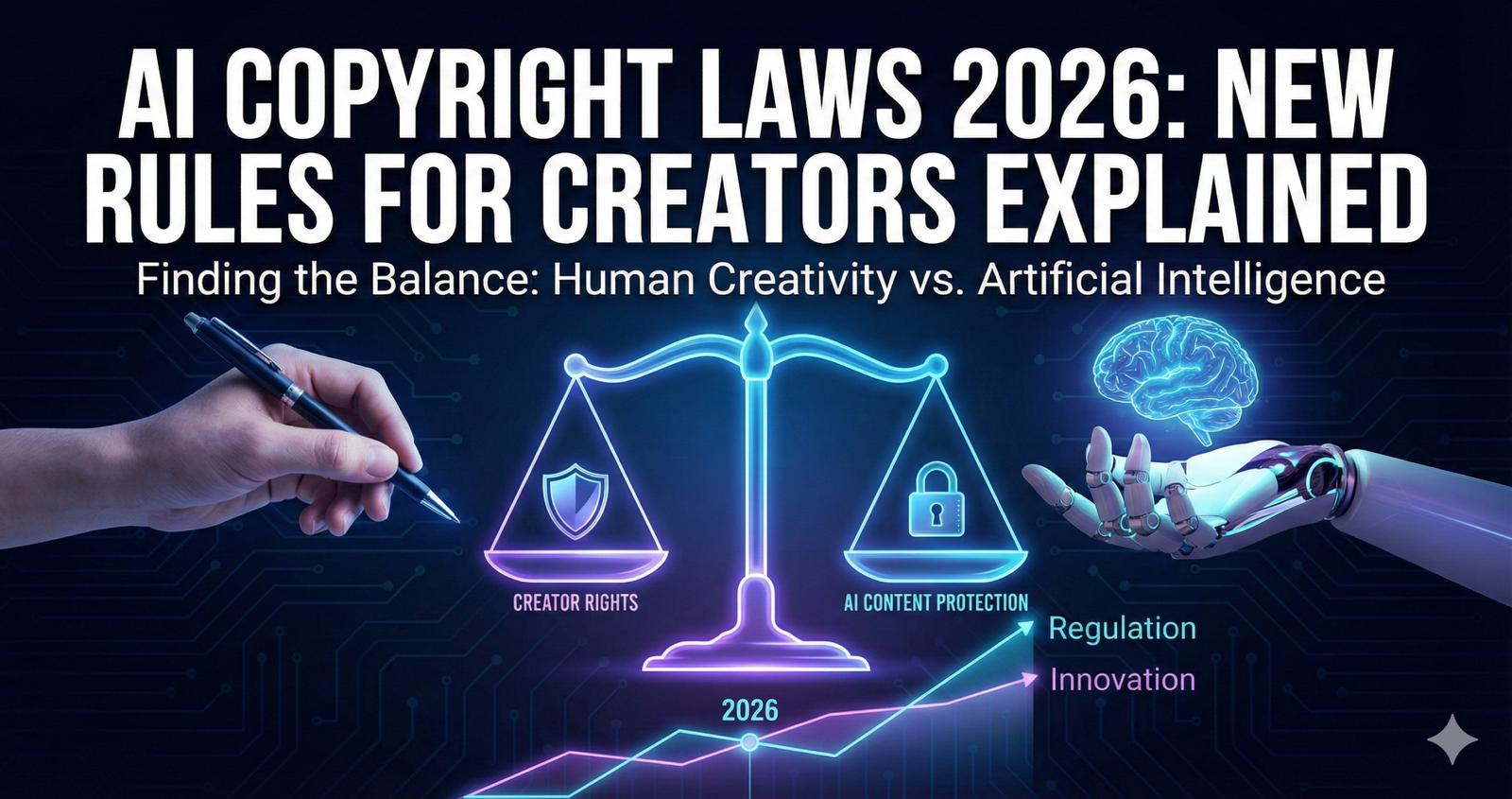
Creating content with AI just got complicated. New laws in 2026 are changing who owns AI-generated work and how creators can protect their rights.
If you use tools like ChatGPT, Midjourney, or DALL-E to create content, you need to know these rules. They affect whether you can copyright your work and if AI companies can legally use your content for training.
The rules are different across countries. What works in the US might not work in Europe. Companies face fines up to €250 million for violations.
This guide breaks down everything you need to know. We explain the new laws in simple terms. You’ll learn how to protect your work and stay legal when using AI tools.
Direct Answer: In 2026, AI-generated content needs substantial human creative input to qualify for copyright protection. Pure AI outputs cannot be copyrighted in the US. Creators must show they meaningfully controlled the creative process beyond simple prompts.
What Changed in 2026
Three major updates reshaped AI copyright this year.
US Copyright Office Released Final Guidelines
In January 2025, the US Copyright Office published Part 2 of their AI report. It clarifies what you can and cannot copyright when using AI tools.
The key rule: You must prove substantial human creativity. Just typing a prompt into ChatGPT or Midjourney doesn’t give you copyright protection.
This applies to all AI-generated content including text, images, music, and video.
EU AI Act Takes Effect
Europe’s AI Act started enforcement in 2026. It requires AI companies to disclose what data they used for training.
The act forces companies to respect copyright opt-outs. If you mark your content as “reserved,” AI companies in Europe must exclude it from training data.
Platforms must label AI-generated content clearly. Users need to know when they’re viewing synthetic content versus human-created work.
New York State Laws for Advertising
New York passed two laws affecting how advertisers use AI. One requires disclosure when ads feature “synthetic performers” created by AI.
The second law protects performers from unauthorized digital replicas. Companies cannot create AI versions of real people without permission.
These laws take effect in June 2026. Violations carry fines from $1,000 to $5,000 per incident.
Can You Copyright AI-Generated Content
The answer depends on how much you contributed to the creative process. Simple prompts don’t count as enough human input, but extensive editing and arrangement might qualify for protection.
When AI Content Gets Copyright Protection
You can copyright your work if you demonstrate substantial creative involvement. Here’s what counts as “substantial”:
Creative Selection and Arrangement: You generate multiple AI outputs, carefully select specific elements, and arrange them into a unique composition. Think of it like assembling a photo collage, where your choices matter.
Significant Editing: You take AI-generated content and modify it extensively. This means rewriting paragraphs, adjusting image compositions, or restructuring music arrangements beyond minor tweaks.
AI as a Tool: You use AI to expand your own human-created work. For example, you sketch a design by hand, then use AI to add details while maintaining control over the final vision.
The US Copyright Office evaluates each case individually. They examine how much creative control you maintained throughout the process.
When AI Content Cannot Be Copyrighted
Pure AI outputs receive no copyright protection. These situations fail the human authorship test:
Simple Text Prompts: You type “create a beach sunset image” into DALL-E and accept whatever it generates. The prompt alone doesn’t constitute creative authorship.
Minimal Modifications: You make tiny changes like adjusting brightness or fixing spelling errors. These don’t add enough original creativity.
Autonomous AI Creation: You let AI generate content start to finish without meaningful human intervention. Even if the result looks impressive, it lacks the required human authorship.
Several court cases confirmed this principle. In 2023, artist Stephen Thaler sued the Copyright Office after they rejected his AI-generated artwork. The court ruled against him, affirming that human authorship remains essential for copyright protection.
The Gray Area: Hybrid Works
Most real-world scenarios fall somewhere between pure AI and pure human creation. These hybrid works create the trickiest questions.
Consider a graphic designer who uses AI to generate background elements, then manually illustrates characters on top. The Copyright Office would likely protect the hand-drawn characters but not the AI-generated backgrounds.
Or imagine a writer who uses ChatGPT to draft blog posts, then rewrites 60% of the content. The rewritten portions might qualify for copyright if they show original creative expression.
Document your creative process. Save drafts showing how you edited AI outputs. Keep records of your creative decisions. This evidence helps prove substantial human involvement if someone challenges your copyright. Similar to how effective prompting techniques require strategic thinking, copyright-worthy AI use demands deliberate creative choices throughout the process.
Europe’s Strict New Requirements
The EU takes a harder stance on AI copyright than the US. Companies operating in Europe face mandatory disclosure and licensing requirements.
Training Data Transparency
Every AI company must publish summaries of their training data. The summary includes what type of content they used (text, images, video, or audio).
This requirement gives creators visibility into how AI models learn. It ensures copyright holders know if their work was used without permission.
Companies cannot hide behind vague statements. They must provide specific information about data sources and types.
Copyright Opt-Out Rights
Creators can now reserve their rights and prevent AI training use. You simply mark your website or content with a copyright reservation notice.
AI developers must check for these reservations before scraping content. If they find a reservation, they must either exclude that content or negotiate a license.
This flips the previous model where companies assumed everything online was fair game for training. Now, explicit permission or absence of opt-out becomes necessary.
Mandatory Content Labeling
Any platform publishing AI-generated content must label it clearly. This applies to text, audio, images, and video.
The goal: Help users distinguish between human and synthetic content. It reduces risks of misinformation and manipulated media.
If your platform generates outputs for public use, labeling becomes legally required. Failure to label can result in substantial penalties.
France’s €250 Million Fine Example
France’s competition authority fined Google €250 million in 2024 for using news articles without permission in training Gemini. This demonstrates how seriously European regulators treat copyright violations in AI training.
The fine sent shockwaves through the AI industry. It proved that training on copyrighted content without proper licensing carries real financial consequences.
Other European countries are watching closely. Similar enforcement actions will likely follow against other major AI companies.
What Fair Use Means for AI Training
US courts are deciding whether training AI on copyrighted material counts as “fair use.” Multiple lawsuits challenge this practice.
The Fair Use Debate
AI companies argue that training models resembles human learning. They say exposing AI to copyrighted content for learning purposes falls under fair use protections.
Copyright holders disagree. Authors, artists, and publishers argue that AI companies profit from their work without permission or compensation.
The legal test considers four factors:
Purpose and Character: Is the use transformative? Does it add new meaning or merely substitute for the original? AI training arguably transforms raw content into learned patterns rather than reproducing works directly.
Nature of the Copyrighted Work: Published factual works receive less protection than creative fiction. AI training on news articles faces weaker claims than training on novels.
Amount Used: Did the AI company use portions or entire works? Most training involves ingesting complete works, which weighs against fair use.
Market Effect: Does AI output compete with original works? If ChatGPT can write articles similar to a journalist’s style, it potentially harms that journalist’s market.
Courts must balance these factors. No single factor determines the outcome.
Major Lawsuits Shaping the Law
Multiple high-profile cases are working through courts right now.
Authors vs. OpenAI and Microsoft: George R.R. Martin and other writers sued, claiming ChatGPT was trained on their copyrighted books without permission. In 2024, Judge Sidney Stein allowed the case to proceed, ruling that juries could find AI-generated Game of Thrones outlines “substantially similar” to the original works.
Getty Images vs. Stability AI: Getty sued Stability AI for copying millions of copyrighted images to train Stable Diffusion. Getty argues this constitutes massive copyright infringement and trademark violation.
Artists vs. Midjourney and others: Visual artists claim image generators were trained on their copyrighted artwork without consent. They seek damages and injunctions preventing future unauthorized use.
The Anthropic Case: Authors sued Anthropic (creators of Claude AI) for training on pirated books. A court ruled in 2024 that using legally purchased books for training might be fair use, but downloading pirated copies definitely wasn’t.
These cases won’t resolve quickly. Appeals could drag on for years. But their outcomes will fundamentally shape AI copyright law going forward.
What This Means for Creators
If courts rule against AI companies, the industry must negotiate licensing deals with content owners. This could dramatically increase AI development costs.
Some experts predict a “licensing economy” where content creators earn royalties when their work trains AI models. Others fear this would strangle innovation by making comprehensive training datasets too expensive.
For individual creators, the uncertainty creates risk. You cannot know if your AI-generated content might face legal challenges until these cases resolve. Much like how businesses navigate evolving AI tool capabilities, creators must stay informed about developing copyright precedents.
Protecting Your Rights as a Content Creator
Whether you create original work or use AI tools, you need strategies to protect your intellectual property.
If You Create Original Content
Your work has value. AI companies want to use it for training. Here’s how to protect yourself.
Add Copyright Notices: Include clear copyright statements on your website, images, and documents. Use the © symbol with your name and year. While not legally required for protection, it signals your intention to enforce rights.
Use Opt-Out Tags: Add metadata tags to your website telling crawlers not to use your content for AI training. Services like Spawning AI offer tools for this.
Monitor AI Outputs: Occasionally check if AI tools generate content suspiciously similar to yours. Services like Copyleaks can detect AI-generated text that might infringe your work.
Register Important Works: In the US, register your most valuable content with the Copyright Office. Registration provides stronger legal standing if you need to sue for infringement.
Join Creator Organizations: Groups like the Authors Guild and Artists Rights Society advocate for creator protections. They provide resources and sometimes legal support.
Consider Licensing Opportunities: Some platforms let you license your work for AI training in exchange for compensation. This gives you control and potential revenue.
If You Use AI Tools for Creation
Document everything when creating content with AI assistance. This evidence becomes crucial if someone questions your copyright.
Save Your Prompts: Keep records of all text prompts you used. Show the thought process and creativity behind your instructions.
Document Your Process: Take screenshots or save versions showing how you edited AI outputs. Prove you didn’t just accept the first result.
Track Your Modifications: Note what you changed, added, or rearranged. Quantify how much of the final work reflects your creative choices versus raw AI output.
Use Human-First Workflows: Start with human creativity, then use AI to enhance. Design a sketch before using AI to add details. Write an outline before asking AI to expand sections.
Understand Tool Terms: Read the terms of service for AI platforms you use. Some claim rights to content you generate using their tools.
Watermark When Possible: If creating images, add watermarks identifying you as the creator. This establishes ownership publicly.
Business and Commercial Use
Companies using AI for commercial purposes face extra considerations. The legal and financial stakes rise significantly.
For Content Creation Businesses
Marketing agencies, publishers, and media companies must adapt their workflows to new copyright realities.
- Develop Clear AI Policies: Document when and how your company uses AI tools. Define what counts as acceptable versus prohibited use.
- Train Your Team: Ensure employees understand copyright implications. They need to know when AI-generated content qualifies for protection and when it doesn’t.
- Review Contracts: Update client contracts to address AI use. Clarify who owns rights to AI-assisted content. Specify what happens if copyright challenges arise.
- Consider Insurance: Some insurers now offer coverage for AI-related intellectual property disputes. As lawsuits multiply, this protection becomes more valuable.
- Audit Your AI Use: Regularly review what AI tools your company uses and how. Ensure compliance with evolving regulations.
For AI Companies and Developers
If you’re building or deploying AI systems, compliance becomes critical.
- Document Training Data Sources: Keep detailed records of where your training data came from. Show you obtained it legally and ethically.
- Implement Opt-Out Mechanisms: Respect creator requests to exclude their content from training. Build systems that honor robots.txt and other opt-out signals.
- Provide Transparency: Publish information about your training data as required by EU regulations and potentially future US laws.
- Label AI Outputs: Make clear when content was generated by AI versus created by humans. This builds trust and ensures regulatory compliance.
- Negotiate Licenses: Form partnerships with content owners to legally access high-quality training data. The Disney-OpenAI deal provides a model for this approach.
- Prepare for Litigation: Set aside resources for potential copyright lawsuits. These cases are expensive and time-consuming.
Practical Examples and Real Cases
Real-world examples help clarify how these abstract rules apply to actual situations.
Case 1: The Rejected Graphic Novel
In 2023, artist Kris Kashtanova created a graphic novel called “Zarya of the Dawn” using Midjourney for illustrations. The Copyright Office initially granted registration, then partially revoked it.
The Office ruled that Kashtanova could copyright the text she wrote and the overall arrangement of images and text. However, the individual Midjourney-generated illustrations received no protection.
This case established important precedent. It showed that hybrid works can receive partial copyright protection for the human-contributed elements.
Lesson: Don’t assume AI-assisted work automatically gets full copyright protection. Be prepared to identify and defend the human-created portions.
Case 2: The Rejected AI Art
Computer scientist Stephen Thaler created an artwork using his AI system called DABUS. He named DABUS as the author on his copyright application.
The Copyright Office rejected the application. Thaler sued, arguing that human authorship shouldn’t be required. In August 2023, a federal judge ruled against him.
The court affirmed that copyright law requires human authors. AI systems cannot hold copyrights, even if they create impressive works autonomously.
Lesson: You cannot copyright work where AI was the sole creator. You must be able to claim meaningful human authorship.
Case 3: The Disney-OpenAI Licensing Deal
In a major shift, Disney and OpenAI signed a $1 billion partnership in late 2025. Disney licensed over 200 characters to OpenAI for use in Sora video generation.
Users can now create short videos featuring Mickey Mouse, Darth Vader, and other Disney characters through prompts. Disney receives compensation and maintains control over how its IP is used.
This deal suggests a future where content owners license their work to AI companies rather than fighting in court. It could become a model for the entertainment industry.
Lesson: Major companies are choosing collaboration over litigation. Expect more licensing deals as the industry matures.
Case 4: Germany’s Music Copyright Victory
In 2024, German music rights organization GEMA successfully sued OpenAI. The court ruled that OpenAI must pay royalties for using copyrighted songs in training.
OpenAI agreed to pay and implement a licensing system. This marked the first major victory for creators seeking compensation for AI training use. Similar to how AI models continue evolving, copyright enforcement is adapting to protect creator rights in the digital age.
Lesson: Courts in different countries are reaching different conclusions. What’s allowed in one jurisdiction might violate laws in another.
What to Expect in the Coming Years
AI copyright law will keep evolving rapidly. Several developments appear likely.
More Licensing Deals
The Disney-OpenAI deal probably won’t be the last. Expect media companies, publishers, and music labels to negotiate similar agreements.
These deals benefit both sides. AI companies get legal access to high-quality training data. Content owners receive compensation and control over their intellectual property.
Smaller creators might band together through collectives to negotiate group licenses. This gives them bargaining power they lack individually.
Clearer Fair Use Standards
As courts rule on pending lawsuits, clearer legal standards will emerge. We’ll better understand when training on copyrighted content qualifies as fair use.
If courts rule broadly in favor of AI companies, training will remain mostly unrestricted. If courts favor copyright holders, AI companies will need to dramatically change their practices.
A mixed outcome seems most likely. Courts might allow training on some types of content while requiring licenses for others.
New Legislation
Congress is considering several AI-related bills. The Generative AI Copyright Disclosure Act would require AI companies to report what copyrighted material they used for training.
Other proposed laws focus on creator compensation, transparency requirements, and safety standards. Some bills might pass in the next few years.
International coordination will increase. Countries will try to harmonize their AI regulations to prevent companies from simply moving to jurisdictions with lax rules.
Technology Solutions
New tools will help creators protect their work and users verify content authenticity.
- Content Credentials: Adobe and others are developing systems that tag content with metadata about its creation. Users can verify whether an image was AI-generated or photographed.
- AI Detection Tools: Services like GPTZero and Originality.ai help identify AI-generated text. These tools will improve as the technology advances.
- Blockchain Copyright Registration: Some platforms use blockchain to create immutable records of content ownership and creation dates.
- Compensation Tracking: Systems might emerge to automatically track when AI uses your content for training and calculate royalties owed.
How Different Countries Handle AI Copyright
Laws vary significantly across major markets. Understanding these differences matters for global creators and businesses.
United States
The US emphasizes human authorship but hasn’t passed comprehensive AI copyright legislation yet. Courts are resolving issues case by case through lawsuits.
Key principles: AI outputs need substantial human creativity for protection. Fair use doctrine might protect some AI training, but courts haven’t fully decided.
The Copyright Office provides guidance but cannot change the law. Only Congress or courts can establish binding precedents.
European Union
Europe takes a more regulatory approach. The AI Act and Copyright Directive create strict rules for transparency, opt-out rights, and content labeling.
Enforcement has teeth. France’s €250 million Google fine demonstrates willingness to penalize violations severely.
The EU prioritizes creator protection over rapid AI development. It assumes AI companies should compensate content owners rather than relying on fair use arguments.
United Kingdom
The UK allows programmers to claim copyright on computer-generated works where “arrangements necessary for creation” came from a human.
This creates a pathway for AI-generated content to receive protection if the programmer can demonstrate they orchestrated the creation process.
However, the UK is reconsidering these rules. Proposed reforms might align more closely with US or EU approaches.
China
China has granted copyright protection to some AI-generated content. A 2023 court ruling held that AI-generated images could be copyrighted if the person using the AI demonstrated creative selection and judgment.
This approach differs from the US position. China seems more willing to extend copyright to AI-assisted works even with limited human involvement.
Japan
Japan has historically taken a permissive stance on AI training. Their copyright law allows using any content for machine learning purposes.
However, Japan is reconsidering this position after international pressure and domestic criticism from creators. Reform proposals would add restrictions on AI training use.
Common Questions Creators Ask
These questions come up repeatedly in copyright discussions about AI.
What if I paid for the AI tool?
Payment doesn’t automatically grant you copyright. You need to demonstrate substantial creative involvement regardless of whether you paid for ChatGPT Plus or Midjourney Pro.
However, paid tools often have better terms of service. They might give you more rights to the outputs than free versions. Always read the specific terms for your tool.
Can I copyright my prompts?
Maybe, if they’re extremely detailed and creative. A simple prompt like “a red car” won’t get protection. But a thousand-word prompt that functions more like a creative brief might qualify as a literary work.
Courts haven’t definitely ruled on this yet. For now, assume prompts alone probably don’t provide strong copyright protection.
What about AI trained on my work without permission?
You might have legal claims, but the law remains unsettled. Join collective actions if you can. Organizations like the Authors Guild represent creators in major lawsuits.
Document when and where you published your work. This evidence helps prove your work existed before the AI training occurred.
Consider publicly opposing unauthorized AI training use. This establishes your position if legal opportunities arise later.
If I edit AI content heavily, is it mine?
Possibly. The key question: Did your edits add substantial original creativity? Small fixes don’t count. Major restructuring, rewriting, or creative arrangement might qualify.
Save versions showing your editing process. This evidence proves your creative contribution if challenged.
Do I need to disclose when I used AI?
Legal requirements vary. Some jurisdictions mandate disclosure for certain uses, particularly in advertising.
Even where not legally required, disclosure builds trust. Many creators voluntarily note when they used AI assistance.
Publishers and clients often require disclosure in contracts. Check your agreements before using AI tools on commissioned work.
7 Frequently Asked Questions
Q1: Can I sell art I made with Midjourney or DALL-E?
Yes, you can sell AI-generated art, but you cannot claim full copyright protection. You own the physical or digital file you created, and most AI tool terms allow commercial use. However, without substantial human creative input beyond the prompt, you cannot prevent others from legally copying your work. To strengthen your position, extensively edit the AI output, combine multiple generations with original elements, or use AI as one tool in a larger creative process. Read your specific AI tool’s terms since some restrict commercial use.
Q2: What happens if someone copies my AI-generated content?
If your content received no copyright protection due to insufficient human authorship, you have limited legal recourse for direct copying. However, you might still protect your work through trade secret laws if you kept it confidential, trademark protection if it serves as a brand identifier, or contract law if the copier agreed not to reproduce your content. Focus on creating AI-assisted works with substantial human involvement, which get stronger legal protection. Document your creative process thoroughly to prove human authorship if disputes arise.
Q3: Is training AI on copyrighted books and images illegal?
The legality remains unresolved in many jurisdictions. In the US, courts are currently deciding whether this practice falls under fair use protections. Some judges have ruled that legally obtaining books and using them for training might be fair use, while downloading pirated copies definitely isn’t. Europe takes a stricter view, requiring AI companies to respect copyright opt-outs and potentially obtain licenses. Until courts definitively rule, AI companies face legal uncertainty and potential liability.
Q4: How do I prove I added enough human creativity for copyright?
Document your entire creative process from start to finish. Save all prompt versions showing how you refined your instructions. Keep intermediate AI outputs before you edited them. Screenshot or save your editing work demonstrating what you changed. Note decisions you made about selection, arrangement, and modification. The more evidence showing deliberate creative choices rather than passive acceptance of AI outputs, the stronger your copyright claim becomes. Consider including time-stamped process documentation in your submission to the Copyright Office.
Q5: Can AI companies use my social media posts for training without asking?
Currently, most AI companies interpret publicly posted content as available for training purposes. However, this practice faces legal challenges, and Europe’s new rules require respecting copyright reservations. You can take steps to limit this use by adding copyright notices to your profiles, using robots.txt files if you have a website, registering with opt-out databases like Spawning AI’s Have I Been Trained, and setting strict privacy settings on platforms that respect them. These measures don’t guarantee protection but demonstrate your intent to reserve rights.
Q6: What’s the difference between copyright and licensing for AI content?
Copyright is the legal right to control reproduction and use of creative works. Licensing is permission you grant others to use your copyrighted work under specified conditions. For AI content, you might not have copyright protection if it lacks human authorship, but the AI platform’s terms of service create a license governing how you can use the outputs. Always read these terms because some platforms retain rights to content generated using their tools, limit commercial use, or require attribution. Licensing can provide more immediate practical protection than uncertain copyright claims.
Q7: Will these laws change again soon?
Absolutely. AI copyright law is evolving rapidly through court decisions, new legislation, and regulatory guidance. Major lawsuits working through courts in 2026 will set important precedents. Congress is considering several AI bills that could change rules significantly. International harmonization efforts might create more consistent global standards. Expect substantial developments every few months rather than years. Follow updates from the US Copyright Office, monitor major court cases, and join creator organizations that track regulatory changes. What’s legal today might change by next year.