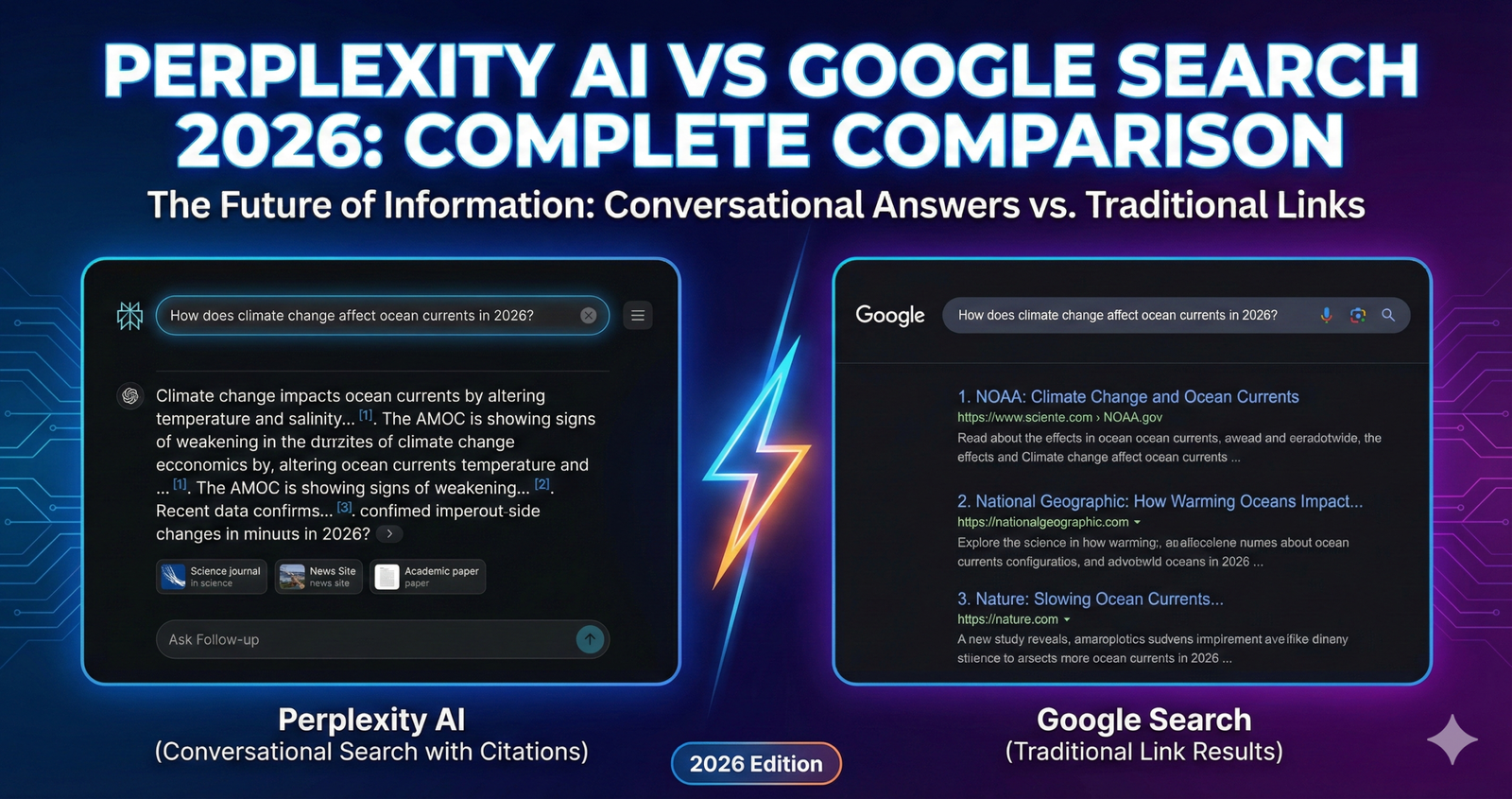
Search is changing fast. Google dominated for 20 years, but now Perplexity AI threatens that reign.
The numbers tell the story. Perplexity grew 800% in one year. It now processes 780 million queries monthly. Users spent over 25 million hours on the platform in December 2025 alone.
Meanwhile, Google added AI features but kept its ad-heavy model. Users complain about scrolling past four ads just to find actual answers.
This guide compares both platforms using real 2026 data. You’ll learn which tool works best for research, local searches, and daily questions. We tested dozens of queries on both to find the truth.
The search war is heating up. Yahoo just launched Scout to compete. ChatGPT added real-time search. The old blue-link model is dying.
Perplexity AI excels at research with cited answers and zero ads. Google Search dominates local searches, shopping, and multimedia results. Perplexity reached $20 billion valuation in early 2026 while processing 780 million monthly queries, challenging Google’s 90% market share with conversational AI-powered answers.
What Changed in 2026
Several major developments reshaped the search landscape this year.
Perplexity Hits $20 Billion Valuation
Perplexity AI’s valuation jumped from $500 million in early 2024 to $20 billion by January 2026. This explosive growth came from multiple $500 million funding rounds.
Investors see genuine potential to challenge Google. The company raised over $1.5 billion total. Major backers include Nvidia, Jeff Bezos, and SoftBank.
Annual recurring revenue exceeded $150 million by end of 2025. Projections forecast $656 million ARR for 2026 and $1.5 billion by 2032.
These aren’t typical startup metrics. Perplexity demonstrates real user adoption and revenue growth, not just hype.
Google Launches AI Search Mode
Google unveiled AI Search Mode at I/O 2025, rolling it out in early 2026. The feature adds conversational AI to traditional search.
Users can switch between normal Google Search and AI Mode. The AI Mode provides detailed answers with sources, similar to Perplexity.
However, Google keeps ads even in AI Mode. The advertising model remains central to their business despite AI integration.
Some users report AI Mode loses context in long conversations. It works well for single questions but struggles with multi-turn research sessions.
Yahoo Enters with Scout
Yahoo launched Scout on January 28, 2026, as a direct competitor to Perplexity and Google AI Mode. The company leverages 30 years of search experience plus new AI capabilities.
Scout shifts from “links to answers” and “search terms to natural language.” It synthesizes information from multiple sources into coherent responses.
Yahoo targets users frustrated with Google’s ad-heavy experience and concerned about Perplexity’s copyright controversies.
The move signals that AI-powered answer engines represent the future, not just a trend. Even declining tech giants see the opportunity.
User Behavior Shifts Dramatically
People search differently now. Instead of typing keywords, they ask full questions. Instead of clicking ten blue links, they expect direct answers.
Perplexity’s user base grew 450% between 2024 and early 2026. Monthly active users reached 15-30 million globally. The platform covers 238 countries and supports 46 languages.
Retention rate hit 85%, showing users stick with the platform once they try it. This sustainable adoption threatens Google’s search monopoly.
Students and professionals increasingly use Perplexity as their first stop for research. Google becomes the backup when Perplexity can’t answer local or shopping queries.
How Perplexity AI Actually Works
Understanding Perplexity’s technology explains why it differs so dramatically from Google.
Conversational Answer Engine
Perplexity calls itself an “answer engine” rather than search engine. The distinction matters.
Search engines give you links to click. Answer engines read those sources and provide synthesized responses. You get the information without visiting multiple websites.
The interface stays minimal. One search bar generates structured answers with bullet points, citations, and follow-up questions.
Users can continue conversations. Ask “What about renewable energy solutions?” after a climate change query. Perplexity remembers context and provides relevant answers.
This feels more like consulting an expert than searching the web. The experience resembles advanced AI assistants that understand conversational flow rather than isolated keyword matching.
Multi-Model AI Routing
Perplexity doesn’t rely on one AI model. It routes questions to the best-suited model from GPT, Gemini, Claude, or Grok depending on query type.
Free users get access to solid base models. Pro subscribers ($20/month) unlock advanced models including GPT-4, Claude 3, and unlimited queries.
The “Pro Search” feature uses multiple models simultaneously for complex research. It cross-references answers and provides more comprehensive responses.
This flexibility beats platforms locked into single AI systems. Different models excel at different tasks.
Real-Time Web Access
Unlike standalone chatbots, Perplexity searches the web in real-time for current information. It doesn’t rely solely on training data from months ago.
When you ask about recent events, Perplexity finds latest news articles, blog posts, and discussions. It processes this fresh content instantly.
Updates typically appear within 30-60 minutes of publication. This proves fast enough for most research but might lag for breaking news.
The system crawls the web actively, despite controversy over ignoring some websites’ Robot Exclusion Protocol. This legal gray area creates ongoing challenges.
Citation Transparency
Every factual claim includes inline citations. Small numbers [1][2] link to source articles.
Users can verify information by clicking citations. This prevents blind trust in AI-generated content and allows fact-checking.
The transparency addresses major AI concerns. Hallucinations still occur, but citations help users spot them by checking source quality.
However, investigations found Perplexity occasionally cites plagiarized content or irrelevant sources. Users must still verify critical information.
How Google AI Search Mode Works
Google added AI without abandoning its core search business model.
Hybrid Traditional and AI
Google AI Mode sits alongside traditional search. Users toggle between them based on needs.
Traditional mode shows familiar blue links, knowledge panels, maps, and shopping results. AI Mode provides conversational answers with some source attribution.
This hybrid approach lets Google experiment with AI while protecting advertising revenue. Ads appear in both modes, maintaining the business model.
The company controls 89.7% of global search market share. They won’t risk that dominance with radical changes.
Powered by Gemini
Google’s own Gemini AI models power the conversational features. The company invested heavily in developing competitive AI to match rivals.
Gemini handles complex queries and provides structured answers. It integrates with Google’s massive knowledge graph for enhanced accuracy.
However, Gemini sometimes generates lengthy responses filled with unnecessary detail. Users report preferring Perplexity’s concise style.
The model also loses context in extended conversations more than Perplexity. Multi-turn research sessions work better on competing platforms.
Integrated Services
Google’s strength lies in service integration. AI Mode connects seamlessly with Maps, Gmail, Calendar, Shopping, Flights, and more.
Ask “cheap flights to Tokyo next month” and get actual bookable options with prices. Perplexity would list travel tips but can’t book tickets.
This ecosystem advantage keeps users in Google’s orbit even as AI answer engines emerge. Convenience matters more than perfect answers for many queries.
The integration reflects decades of development. Startups can’t replicate this breadth overnight.
Ad-Supported Model
Google makes money from ads, not subscriptions. This fundamental difference shapes the entire experience.
The company must balance answer quality against ad revenue. Providing perfect direct answers reduces clicks to advertiser sites.
Users notice this tension. Complaints about ad bloat, SEO spam, and declining result quality increased throughout 2025.
Perplexity’s subscription model aligns with user interests. They profit from happy subscribers, not ad clicks. This creates better incentive alignment for pure answer quality.
Head-to-Head Comparison
Real-world testing reveals strengths and weaknesses of each platform.
Research and Deep Dives
Test: “Explain how photosynthesis works in simple terms.”
Perplexity: Delivered structured answer in four sections with images, sources, and step-by-step explanation. Total time: 8 seconds.
Google AI Mode: Provided lengthy paragraph answer with some formatting. Included knowledge panel and educational videos. Total time: 5 seconds.
Winner: Perplexity. The structured format with citations made complex information more digestible. Google’s answer was accurate but less organized.
Current Events
Test: “Latest developments in AI regulation January 2026.”
Perplexity: Listed recent news articles chronologically with publication dates. Showed conflicting viewpoints from different sources clearly.
Google: Mixed recent and older articles. AI Mode summary sometimes missed latest developments from past 24 hours.
Winner: Perplexity. Better at surfacing very recent information with clear timestamps and source diversity.
Local Searches
Test: “Best pizza place near me open now.”
Perplexity: Listed pizza places from Yelp reviews. Provided general information but no real-time hours, maps, or photos.
Google: Showed interactive map with locations, live opening hours, photos, ratings, phone numbers, and directions.
Winner: Google. Perplexity can’t compete with Google Maps integration for local business queries.
Shopping
Test: “Best noise-canceling headphones under $200.”
Perplexity: Summarized reviews from tech sites. Listed specific models with key features but no prices or purchase links.
Google: Shopping results with current prices, retailers, images, comparison tools, and user reviews.
Winner: Google. Shopping integration makes actual purchases easier despite some sponsored results.
Coding Help
Test: “How to fix ‘cannot read property of undefined’ error in JavaScript.”
Perplexity: Explained common causes with code examples. Provided troubleshooting steps and prevention tips.
Google: Linked to Stack Overflow discussions and documentation. Required clicking through multiple sources.
Winner: Perplexity. Direct answer with code examples beat link clicking for technical problem-solving.
Academic Research
Test: “Recent studies on climate change impact on coral reefs.”
Perplexity Pro: Found peer-reviewed papers with publication dates. Summarized key findings with academic citations.
Google Scholar: Listed relevant papers but required manual reading. Google AI Mode provided surface-level summary.
Winner: Perplexity Pro. Deep Research mode specifically targets academic use cases effectively.
Strengths and Weaknesses
Each platform excels in specific scenarios while struggling in others.
Perplexity AI Strengths
Zero Ads: Clean interface with no advertising clutter. Every pixel serves user needs rather than revenue generation.
Citation Quality: Transparent sourcing allows fact-checking. Users see exactly where information comes from.
Research Focus: Purpose-built for finding and synthesizing information efficiently. The conversational interface encourages exploration.
Concise Answers: Gets to the point without unnecessary elaboration. Respects user time by delivering information efficiently.
Context Retention: Remembers conversation threads for multi-turn queries. Natural back-and-forth feels like consulting an expert.
Perplexity AI Weaknesses
Hallucination Risk: AI sometimes generates confident-sounding but incorrect information. Citations don’t guarantee accuracy if sources themselves contain errors.
Limited Local Data: Can’t compete with Google Maps for local business queries. No real-time hours, reservations, or integrated reviews.
No Shopping Integration: Lists product recommendations but can’t show prices or enable purchases. Users must go elsewhere to buy.
Copyright Controversies: Legal challenges around web crawling and content usage. Some websites block Perplexity access.
Slower Updates: Recent information takes 30-60 minutes to appear. Breaking news coverage lags real-time sources.
Google Search Strengths
Local Integration: Maps, business hours, photos, reviews, and directions all work seamlessly. Unbeatable for “near me” searches.
Shopping Experience: Price comparison, availability, retailers, and user reviews in one place. Actual purchase capability built in.
Multimedia Results: Images, videos, news, maps, and text results all available. Comprehensive coverage of different content types.
Real-Time Information: Breaking news and live data update instantly. Stock prices, sports scores, and trending topics stay current.
Ecosystem Integration: Works with Gmail, Calendar, Drive, Photos, and other Google services. Convenience through interconnected tools.
Google Search Weaknesses
Ad Overload: Users scroll past multiple ads before reaching organic results. Sponsored content clutters the experience.
SEO Spam: Low-quality sites rank high through keyword manipulation. Users waste time on thin content optimized for algorithms.
Link Fatigue: Still requires clicking multiple sites to piece together complete answers. Time-consuming compared to direct answers.
AI Mode Limitations: Loses context in extended conversations. Not as refined as dedicated answer engines.
Conflicted Incentives: Profit from ads creates tension with delivering perfect answers. Better answers mean fewer ad clicks.
Use Case Recommendations
Choose the right tool based on your specific needs.
Use Perplexity AI For:
Academic Research: Citations and multi-source synthesis help verify information and build comprehensive understanding.
Technical Problem-Solving: Code debugging, configuration issues, and troubleshooting benefit from direct answers with examples.
Exploring New Topics: Conversational interface encourages following curiosity through related questions naturally.
Ad-Free Experience: When you need focused research without distraction or commercial influence.
Synthesizing Multiple Sources: Comparing different perspectives or finding consensus across various viewpoints.
Use Google Search For:
Local Queries: Finding nearby businesses, restaurants, services with hours, locations, and contact information.
Shopping: Product research, price comparison, availability checking, and actual purchasing.
Recent Breaking News: Immediate updates on developing stories and real-time information.
Multimedia Content: Finding specific images, videos, or diverse content formats.
Service Integration: When you need results connected to Calendar, Maps, Gmail, or other Google tools.
Hybrid Approach Works Best:
Many power users combine both platforms strategically. Use Perplexity for research and concept understanding. Switch to Google for local information, shopping, and integrated services.
This workflow maximizes strengths while minimizing each platform’s weaknesses. Similar to how professionals use different AI tools for different tasks, combining search platforms optimizes productivity.
Privacy and Ethics Concerns
Both platforms face scrutiny over data practices and content usage.
Perplexity’s Controversies
Investigations revealed Perplexity ignores the Robot Exclusion Protocol on some websites. This allows crawling content even when site owners object.
Copyright lawsuits claim the platform reproduces content without permission. Publishers argue Perplexity profits from their work while sending zero traffic.
The company faced plagiarism accusations from Forbes and Wired. Reports showed Perplexity outputs closely mirroring original articles without proper attribution.
These legal challenges threaten the business model. Settlements or adverse rulings could force major operational changes.
However, Perplexity argues they transform content through AI analysis rather than simply copying. The legal outcomes remain uncertain.
Google’s Data Collection
Google tracks user searches, clicks, and behavior across services. This data powers targeted advertising worth billions annually.
Privacy advocates criticize the extensive profiling. Google knows more about users than any other company globally.
The ad-supported model inherently conflicts with privacy. Better targeting requires more data collection, creating constant tension.
Google offers some privacy controls but defaults to maximum data collection. Users must actively opt out rather than opt in.
What Users Can Do
For privacy-conscious searchers, tools like Brave Search or DuckDuckGo offer alternatives. These prioritize anonymity over personalization.
Perplexity provides better privacy than Google by avoiding extensive tracking. However, their copyright issues create different ethical concerns.
No perfect solution exists yet. Users balance privacy preferences against feature needs when choosing platforms.
Mobile Experience Comparison
Most searches happen on phones, making mobile experience critical.
Perplexity Mobile App
The Perplexity app feels minimalist and voice-first. Opening it presents one search bar without clutter.
Voice Mode works excellently for hands-free queries. The interface encourages speaking questions naturally rather than typing keywords.
Answers load quickly even on slower connections. The streamlined design reduces data usage compared to Google’s multimedia-heavy results.
However, limited local integration makes “near me” searches frustrating. No integrated maps or real-time business information.
Google Mobile App
Google’s app opens to a “Discover” feed filled with news, sports scores, and personalized content. Some users appreciate this but others find it distracting.
The interface feels bloated with features. Finding the actual search bar requires dismissing various prompts and suggestions.
However, Google integrates Maps, Shopping, and other services seamlessly on mobile. Switching between search types happens instantly.
Voice search works well but feels less conversational than Perplexity. Google processes voice as text input rather than true dialogue.
Winner: Depends on usage. Perplexity wins for focused research. Google wins for general mobile tasks involving maps, shopping, and services.
Cost Comparison
Pricing models differ fundamentally between platforms.
Perplexity Pricing
Free tier provides solid basic features. Users get standard AI models with limited daily queries.
Perplexity Pro costs $20/month and includes:
- Unlimited queries with no daily limits
- Access to GPT-4, Claude 3, and advanced models
- Pro Search using multiple AI models simultaneously
- API access for developers
- Image generation and file upload capabilities
The subscription model aligns incentives with user satisfaction. Perplexity profits when users renew, not when they click ads.
For heavy researchers and professionals, $20 monthly proves worthwhile. Students and casual users often find the free tier sufficient.
Google Pricing
Google Search remains completely free for all users. No subscription tiers or paywalls exist.
The company monetizes through advertising instead. Users pay with attention, data, and ad exposure rather than money.
This “free” model appeals to casual searchers. However, ad avoidance and SEO spam create hidden time costs.
Power users might actually save time with Perplexity’s paid tier despite the monetary cost. Efficiency gains offset subscription fees.
Value Assessment
For research-heavy workflows, Perplexity Pro delivers clear value. Saved time and better answers justify $20 monthly easily.
For occasional searching, shopping, and local queries, free Google makes more sense. Most people don’t need premium search features.
The market supports both models because different users have different needs.
What Experts Predict
Industry analysts forecast continued evolution in search technology.
AI-First Search Becomes Standard
Within 2-3 years, most search engines will offer AI-powered answer modes as standard features. The link-list model will feel outdated.
Google’s dominant market share protects them short-term but doesn’t guarantee long-term survival if user preferences shift dramatically.
Younger users increasingly expect direct answers rather than link clicking. This generational preference drives platform evolution.
Consolidation or Fragmentation
Two scenarios compete. Either a few dominant players emerge (Google, Perplexity, ChatGPT Search) or the market fragments across specialized tools.
Fragmentation seems more likely. Different search types (research, local, shopping, social) might use different platforms optimized for each.
The “one search engine for everything” model may disappear as specialized tools outperform general solutions.
Regulation and Copyright Battles
Government regulation will reshape AI search practices. Copyright disputes will force clearer content usage rules.
Perplexity and similar platforms might need licensing agreements with publishers. This could increase costs or limit content access.
Alternatively, courts might rule that AI training and synthesis qualify as fair use. This would validate current practices legally.
Voice and Multimodal Search
Future search interfaces emphasize voice, images, and video as inputs. Typing queries will feel inefficient.
Multimodal AI that processes text, images, and voice simultaneously will power next-generation search. Google’s Gemini and OpenAI’s GPT-4 Vision lead this direction.
Search results will include generated images, videos, and interactive elements rather than just text and links. Much like AI video generation transforming content creation, multimodal search will revolutionize information discovery.
Latest News January 2026
Recent developments continue reshaping the competitive landscape.
Yahoo Scout Launch (January 28)
Yahoo’s entry validates the AI answer engine market. Even companies outside the AI forefront recognize the shift.
Scout emphasizes Yahoo’s 30 years of search experience plus modern AI capabilities. The messaging targets users frustrated with both Google’s ads and Perplexity’s controversies.
Early reviews suggest Scout performs adequately but doesn’t clearly surpass competitors. It may carve a niche without threatening market leaders.
Perplexity India Investment
Perplexity announced $400 million investment in India for 2026. This signals serious international expansion beyond U.S. markets.
Partnership with Airtel generated 640% user growth in India. The strategy focuses on mobile-first markets where Google’s dominance isn’t absolute.
Covering 238 countries and 46 languages positions Perplexity as genuinely global rather than U.S.-centric.
Snapchat Integration
Perplexity integrated with Snapchat, providing access to nearly 1 billion users. This distribution dramatically expands potential reach.
Young users discovering Perplexity through Snapchat might adopt it permanently. Early platform exposure builds long-term habits.
The integration shows Perplexity pursuing growth through partnerships rather than direct competition alone.
Google AI Mode Expansion
Google continues expanding AI Mode availability globally. Markets outside the U.S. gradually gain access throughout early 2026.
The company experiments with reducing ads in AI Mode for some queries. This tests whether better user experience might offset reduced ad inventory.
However, fundamental business model changes seem unlikely. Advertising generates too much revenue to abandon.
Common Problems and Solutions
Users encounter predictable issues with both platforms. Here’s how to solve them.
Problem: Perplexity Gives Wrong Information
AI hallucinations create confident-sounding but false answers. This risks spreading misinformation.
Solution: Always click citations to verify sources. Cross-reference critical facts with official documentation. Use Perplexity for initial research, then validate important claims.
Problem: Google Results Full of Ads and Spam
SEO manipulation and advertising clutter search results. Finding quality information requires scrolling and filtering.
Solution: Add “site:edu” or “site:gov” to searches for authoritative sources. Use Google Scholar for academic information. Consider uBlock Origin to hide ads.
Problem: Perplexity Lacks Local Information
“Near me” searches produce generic results without maps, hours, or real-time data.
Solution: Use Google for local queries. Switch to Perplexity for follow-up research about selected businesses or services.
Problem: Google AI Mode Loses Context
Extended research sessions see Google forgetting previous questions and context.
Solution: Use Perplexity for multi-turn conversations. Export results and use Google for specific follow-up needs.
Problem: Information Seems Outdated
Both platforms sometimes surface old information despite recent developments.
Solution: Add time qualifiers like “2026” or “this month” to queries. Check publication dates on sources. Use news-specific search modes.
7 Frequently Asked Questions
Q1: Is Perplexity AI actually better than Google Search?
It depends entirely on what you need. Perplexity excels at research, providing cited answers without ads or SEO spam. Google dominates local searches, shopping, and multimedia results through Maps, Shopping, and ecosystem integration. For academic research or technical problem-solving, Perplexity’s conversational interface and citations prove superior. For finding nearby restaurants, booking services, or shopping, Google’s integrated tools remain unbeatable. Most power users combine both platforms strategically rather than choosing one exclusively. Use Perplexity for deep research and concept understanding, then switch to Google for local information and transactions.
Q2: Can I trust Perplexity AI’s answers without fact-checking?
No. While Perplexity provides citations, AI hallucinations still occur. The platform sometimes generates incorrect information that sounds authoritative, or cites sources that themselves contain errors. Always verify critical facts by clicking citations and checking source credibility. Treat Perplexity as a research assistant providing starting points, not final authoritative answers. The citation feature helps verification but doesn’t eliminate the need for it. For medical, legal, or financial decisions, consult qualified professionals rather than relying solely on AI answers. Cross-reference important claims across multiple reliable sources before accepting them as fact.
Q3: Why is Perplexity’s valuation so high at $20 billion?
Investors see genuine potential to disrupt Google’s search monopoly. Perplexity demonstrated 800% user growth in one year and 85% retention rate, proving sustainable product-market fit. The platform processes 780 million monthly queries with annual recurring revenue exceeding $150 million. The subscription model aligns better with user interests than ad-supported search, creating potential for premium product positioning. Additionally, the AI-native design positions Perplexity ahead of legacy platforms adapting AI onto old architectures. Investors bet that conversational answer engines represent the future of search, and Perplexity leads that category with technical and market advantages.
Q4: Does using Perplexity hurt content creators and publishers?
This remains hotly debated. Publishers argue Perplexity synthesizes their content and keeps users on its platform, eliminating traffic and ad revenue for original creators. Investigations found instances of near-plagiarism where Perplexity outputs closely mirrored source articles. However, Perplexity counters that citations drive traffic to sources and AI synthesis constitutes transformative fair use. The legal and ethical questions remain unresolved with multiple lawsuits pending. Users concerned about supporting content creators should click through citations to original sources and consider that ad-free search experiences necessarily disrupt ad-based publishing models regardless of specific platform practices.
Q5: Is Google Search getting worse or am I imagining it?
You’re not imagining it. Multiple studies and user surveys throughout 2025 confirmed declining Google Search quality. SEO manipulation increased as more sites optimized for algorithms rather than users. Ad loads expanded, pushing organic results lower on pages. AI content farms flooded results with low-quality but keyword-optimized material. Google’s business model creates inherent conflict—providing perfect direct answers reduces ad clicks and revenue. The company balances user experience against profitability, and recent years tipped toward monetization. However, competition from Perplexity and others might force quality improvements as users gain viable alternatives. Market pressure could improve Google faster than internal motivation alone.
Q6: Will AI search engines like Perplexity replace Google completely?
Unlikely in the near term. Google’s 90% market share, integrated services ecosystem, superior local data, and shopping integration create massive switching costs. Most users will adopt AI answer engines for specific use cases while keeping Google for others. However, long-term trends favor AI-first search as younger users prefer direct answers over link clicking. The market will likely fragment with different tools for different search types rather than one universal replacement. Google’s search monopoly faces genuine threat for the first time since its establishment, but complete replacement seems improbable given entrenched advantages across local, shopping, and service integration.
Q7: Should I pay $20 monthly for Perplexity Pro?
Yes, if you conduct significant research regularly for work or studies. The unlimited queries, advanced AI models, and Pro Search features save substantial time for research-heavy workflows. Students writing multiple research papers, professionals conducting market analysis, or developers debugging code frequently find clear value. However, casual users checking weather, finding restaurants, or occasional web searches won’t benefit enough to justify the cost. The free tier provides adequate functionality for light usage. Consider your monthly search patterns—if you spend multiple hours weekly on research tasks, Pro pays for itself through efficiency gains. Otherwise, stick with free Perplexity supplemented by Google for other needs.