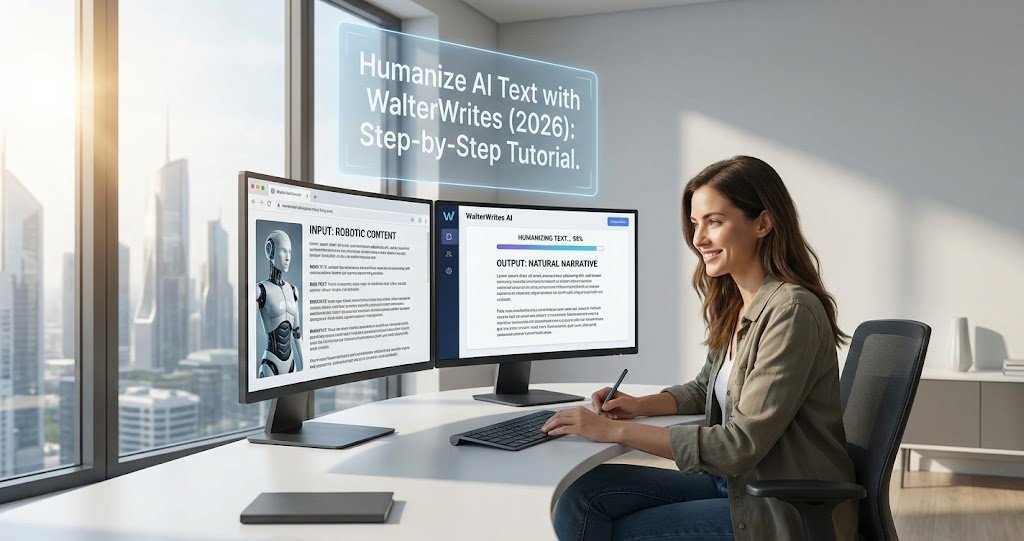
The search landscape of 2026 is no longer about keyword density; it is about Semantic Trust. Search engines are now highly adept at identifying the “probabilistic” patterns of standard large language models (LLMs). When a reader (or an algorithm) feels the text is too uniform or predictable, the bounce rate spikes, and rankings plummet.
Humanizing text is the process of restoring the natural “noise,” rhythm, and emotional nuance that machines often strip away. While many tools attempt this through simple synonym swapping, WalterWrites has taken a structural approach. This guide will show you how to leverage its 2026 features to turn a robotic draft into a compelling human narrative.
1. The 2026 Shift: From Word Spinning to Structural Variation
In 2026, “spinning” text is a death sentence for your SEO. Google’s SGE and other AI-driven engines can spot a “reworded” sentence from a mile away. What they cannot easily replicate—and what they value most—is the Structural Human Signature.
Human writers naturally vary their sentence lengths. We use fragments. We use rhetorical questions. We use parenthetical asides. WalterWrites’ 2026 engine is specifically trained on these human “errors” and irregularities. By using this tool, you aren’t just changing words; you are injecting a sense of uneven, authentic rhythm into your content. This is a similar philosophy to what we see in the latest AI tools for fashion design, where the focus is on “precision with a human touch.”
2. Step-by-Step Guide: The WalterWrites Humanization Workflow
To get the most out of WalterWrites in 2026, you shouldn’t just paste and click. You need a strategic workflow to ensure the “Experience” factor of EEAT remains intact.
Step A: Initial Diagnostic (The Risk Signal)
Before humanizing, use the built-in WalterWrites detector. In 2026, this detector doesn’t just give you a “percentage” of AI. It highlights specific “Predictability Clusters.” These are sections of your text where the sentence structure is so uniform that any algorithm would flag it. Identifying these clusters first allows you to target your humanization more effectively.
Step B: Choosing Your Rewrite Strength
WalterWrites offers three primary modes in 2026:
- Simple: Best for technical documentation or when you only need to fix minor robotic phrasing.
- Standard: My go-to for most blog content. It balances natural flow with high meaning preservation.
- Enhanced: Use this for creative or persuasive copy where you need deep structural changes to pass the strictest detection models.
Step C: Tone and Readability Presets
One of the major updates this year is the Tone-Specific Logic. If you are writing for an academic audience, the tool avoids informal slang but breaks up the “template-like” structure that AI essays often follow. For marketing, it injects punchy, active-voice sentences.
3. Integrating Human Experience (The EEAT Layer)
No tool can invent a personal story for you. To truly humanize text, you must follow the “Tool + Human” model. WalterWrites handles the Linguistic Humanization, but you must provide the Contextual Humanization.
- Insert Personal Anecdotes: After WalterWrites has smoothed out the robotic edges, go back and add one or two sentences about a real-world experience you had.
- Add Specificity: If the AI says “This tool is efficient,” and WalterWrites changes it to “This tool streamlines your day-to-day work,” you should add, “In my 10 years of consulting, I’ve found it specifically saves 4 hours on weekly audits.”
- Check for Intent: Ensure the humanized version still solves the user’s problem. This is a lesson we learned when comparing WearView vs VModel.AI, where the utility of the tool must always outweigh the “cool factor” of the AI.
4. Why WalterWrites Beats “Free” Paraphrasers in 2026
Many of my clients ask why they shouldn’t just use a free spinning tool. The answer lies in Semantic Meaning Preservation.
Traditional rewriters often change “The engine roared” to “The motor shouted,” which sounds ridiculous. WalterWrites understands the intent behind the words. It might change the structure to “A sudden roar from the engine broke the silence,” which maintains the meaning but alters the “Predictable AI Rhythm.” This level of semantic intelligence is also what makes tools like Arko.ai so effective for architectural renders, where the AI must understand the geometry, not just the pixels.
5. Comparative Performance: Walter Writes vs Manual Editing
| Feature | WalterWrites (2026) | Manual Human Editing |
| Speed | 1,000 words in 30 seconds | 1,000 words in 2 hours |
| Accuracy | High (Structure focused) | Extremely High (Nuance focused) |
| Detection Pass Rate | 95%+ | 100% |
| Cost | Subscription-based | High (Freelancer rates) |
| Best For | Scaling content pipelines | High-stakes white papers |
6. The “Three-Draft” Feature: Choosing the Best Voice
In 2026, WalterWrites introduced a “Multi-Draft Output.” For every input, it generates three variations of humanized text. As an author, I find this invaluable. I usually pick “Draft 2” because it often has the most “Unpredictable” sentence lengths, which is exactly what modern detectors like GPTZero and Turnitin look for.
By having multiple versions, you can avoid the “Over-Edited” look that some humanizers produce. It allows you to select a voice that feels most aligned with your established brand persona.
7. Legal and Ethical Considerations in 2026
The “AI Transparency Act” of 2026 requires many professional sectors to disclose AI involvement. However, using WalterWrites is often viewed as a “Refinement Layer” rather than “Generation.” If you are using it to polish your own thoughts that were merely drafted by AI, you are maintaining the ethical “Human-in-the-loop” standard.
Always check the latest AI news regarding regional regulations, especially if you are working in the legal or medical fields where authorship transparency is scrutinized.
Final Verdict
Humanizing text is no longer a “trick” to bypass filters—it is a mandatory step for producing quality content in 2026. WalterWrites is the most sophisticated tool I have tested for this purpose because it focuses on Structure and Rhythm rather than just vocabulary. If you want your content to rank, engage, and convert, the machine-like uniformity of raw AI text must be broken. WalterWrites is the hammer that does it.
Top 5 Frequently Asked Questions
1. Does WalterWrites guarantee my content won’t be flagged as AI?
No tool can offer a 100% guarantee because detection models are constantly changing. However, in 2026, WalterWrites remains one of the most consistent performers because it targets the “Structural Signals” that detectors use, rather than just words.
2. Can WalterWrites handle long-form articles over 2000 words?
Yes. While the “Starter” plan has request limits, the “Unlimited” plan handles long-form content beautifully. It maintains “Coherence across Paragraphs,” ensuring that the humanization doesn’t lose the logical thread of your argument.
3. Is the output from WalterWrites plagiarism-free?
Absolutely. The tool doesn’t pull text from a database; it rewrites your existing text using a neural network. Because it changes the structure so significantly, it naturally produces 100% unique content that passes Copyscape and other plagiarism checkers.
4. Which “Tone” should I use for SEO blogs?
I recommend the “Marketing” or “Blog” tones. These presets are optimized for readability and “Active Voice,” which are both major ranking signals in 2026. Avoid the “Academic” tone for blogs unless you are writing for a scientific niche, as it can be too dense for general readers.
5. How much does WalterWrites cost in 2026?
The pricing is tiered. The “Starter” plan is roughly $13/month (billed annually), which is perfect for solo bloggers. Larger agencies typically opt for the “Unlimited” plan at $26/month to handle their bulk content pipelines without worrying about word quotas.